


 English
The Chairperson paid tribute to our long-standing member Winston Gourley who had passed away recently. Winston brought much knowledge and joy to our meetings and will be sadly missed.
The Chairperson informed us that Ulster Wildlife have appointed Ann Ward as Nature Project Officer for the Mid Ulster. Ulster Wildlife are joining with Mid Ulster Council to deliver a new initiative called “Uniting for Nature” with the launch meeting at Pomeroy Forest Centre on 4th December.
The Chairperson then introduced our speaker for the night. James Napier has an Honours Degree in Biology, an MSc in Contemporary Biology and did his PhD on the Evolutionary Ecology of Wild Garlic. James taught at Dungannon Royal School and later Wallace High School where he became Vice-Principal. He was Chief Examiner for A Level Biology until 2023. He is author and co-author of over 20 Science and Biology textbooks. He writes a monthly article for the Down Recorder Newspaper. He is also author of the excellent little book “An Introduction to the Wildflowers of Northern Ireland” Photography is his hobby with a focus on landscapes and nature. James’s subject for our talk was “Photographing Nature with a Smart Phone”
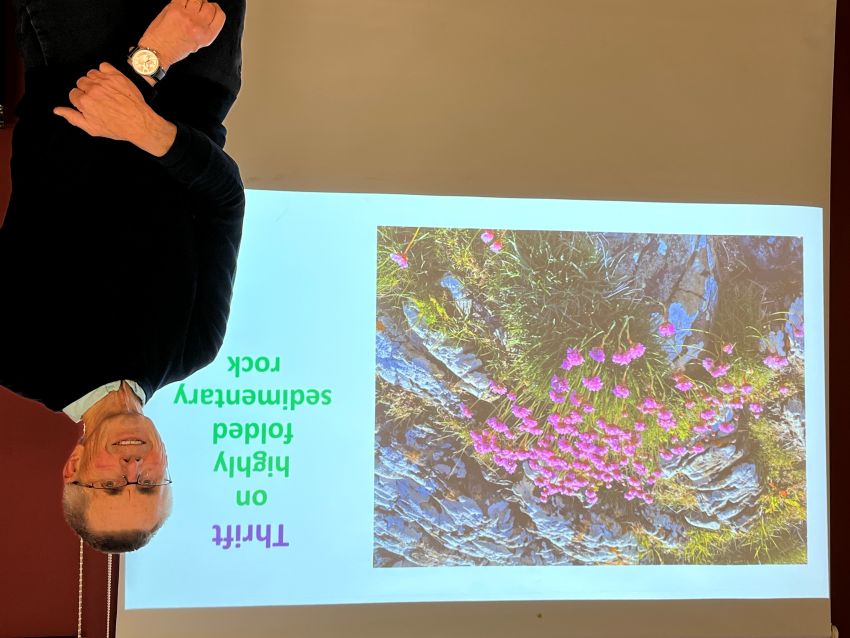
James Napier BSc. MSc. PhD
James explained he uses quite an old phone—Apple i Phone 13 Pro Max. Of course, a smart phone is only of use to photograph stationary plants or slow-moving animals such as limpets or sea anemones and is not of use to take picture of fast animals, difficult to access organisms or microscopic structures.
Photographing plants at low magnification allows a wider field of view and a greater depth of focus. This allows one to include interesting background features. For example James showed pictures of bird’s-foot-trefoil with Gunn’s Island in the background and hare’s-tail cottongrass with Belfast Lough in the background.
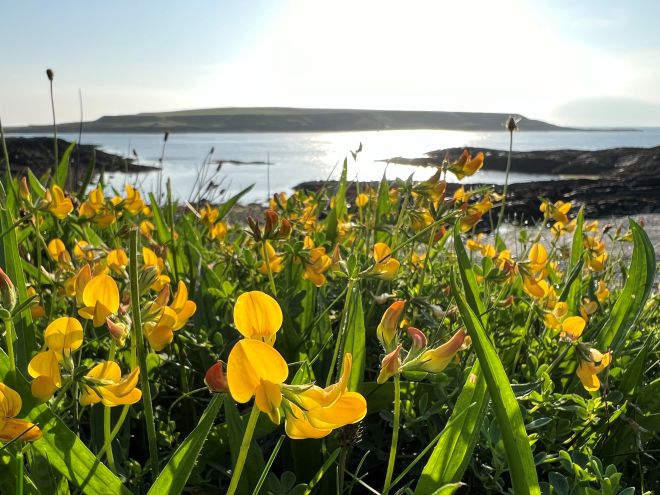
Bird-foot trefoil (Lecale Coast with Gunn's Island in background) by James Napier
James gets up sometimes as early as 6 am to get perfect light conditions, for example to capture a sunrise over Belfast Lough. A lot of his botany photos are taken from ground level.
Background features add a lot. James showed us a picture of thrift but with an interesting background of folded sedimentary rocks with lichens on top –geology is another of his interests.
James spent 10 years researching and studying wild garlic—the subject of his PhD. He explained wild garlic can grow in very dark habitats as it has crystal-like structures on the top of its leaves which refract light into the chloroplasts. These crystals can only be properly examined with an electron microscope.
When background is less important plants can be photographed at high magnification. James showed us the beautiful green-winged orchid which only grows in one very confined area in a coastal site in Co Down. This year it suffered severely from drought as did a lot of other wildflowers.
Photographing plants at the edge of water helps reduce unwanted background clutter on pictures.
He showed us a photo of a lesser butterfly orchid taken in pristine condition at Montiagh’s Moss. James remarked that there was a path trampled through the grass to this plant as it was popular with photographers! Indeed, some of us had taken photos of this very plant on our CWT outing there last year but had failed to produce anything close to the result that James had produced!
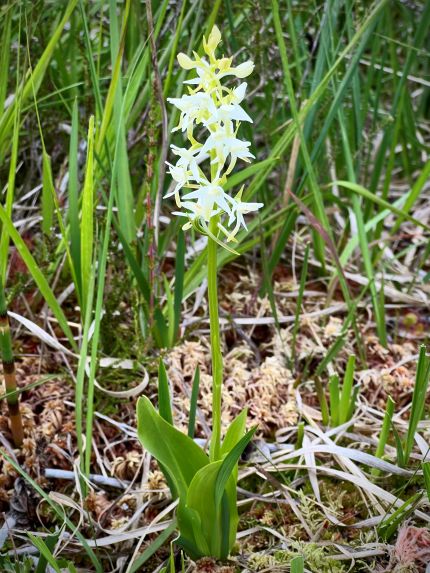
Lesser Butterfly Orchid at Montiagh's Moss--by James Napier
The symmetry of nature is remarkable—greater stitchwort with 5 petals, 5 stamens between petals, above 5 sepals. All is on a single stalk that needs to balance perfectly. We were shown beautiful pictures of devil’s-bit scabious taken at Slievenacloy Nature Reserve with its inflorescence of 30-40 magenta flowers on one stalk.
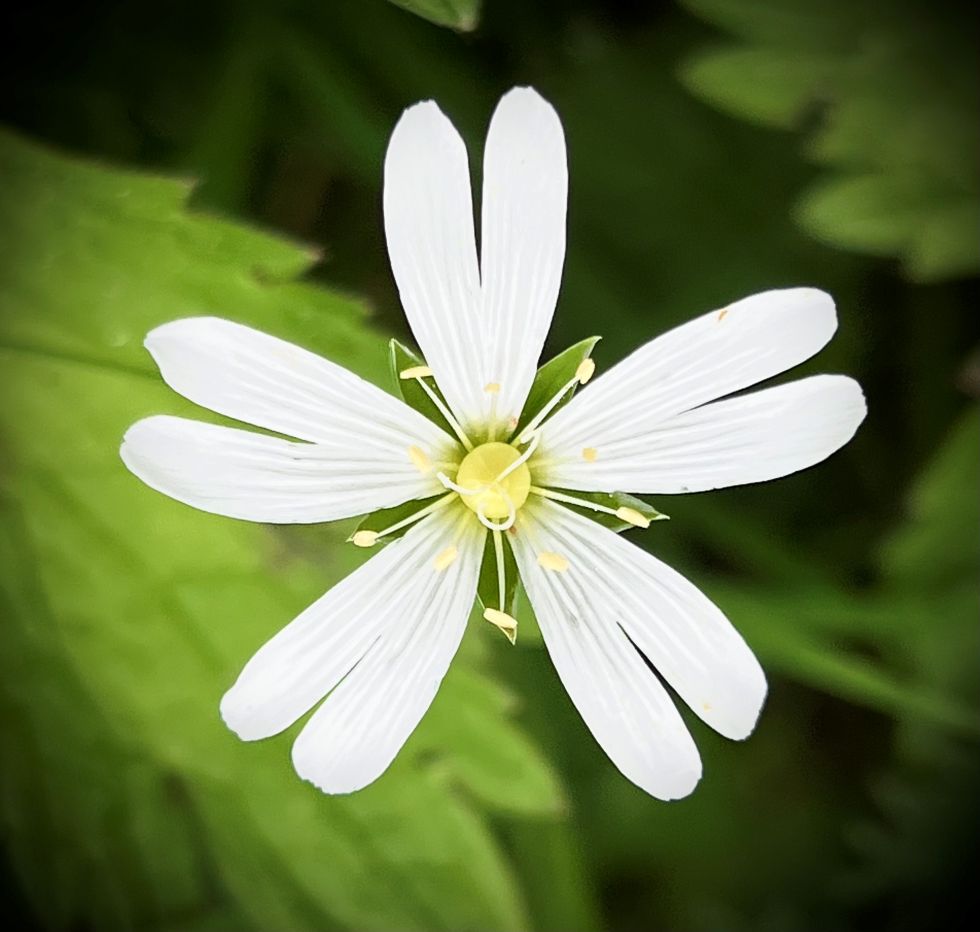
Greater stitchwort (the beautiful symmetry of nature)--photo by James Napier
We learnt that lichens (which are a combination of a fungus and an algae) grow best on flat rocks-James had some remarkable pictures of lichens growing on Hadrian’s Wall. Lichens grow until they abut against another lichen and then mysteriously stop.
James showed us some beautiful pictures of fungi, fly agaric, porcelain fungi, glistening inkcap with their almost mica like crystals on their surface, yellow staghorn, scarlet elf-cup —this autumn 2025 has been a bumper time for fungi.
A smart phone can be used effectively to photograph butterflies. James had taken a photo of a green-veined white on rocks for contrast. This had stunning detail clearly showing its long proboscis. Similarly, stunning photos of red admiral, small tortoiseshell, a drone fly, and an oil beetle.
James then talked about photographing nature in its broadest sense, that is landscapes like Broadwater Lake near Moira taken with the mist rising and two obedient swans helping to break up the picture. Another picture of the Mournes looking particularly foreboding etc. All with a smart phone!
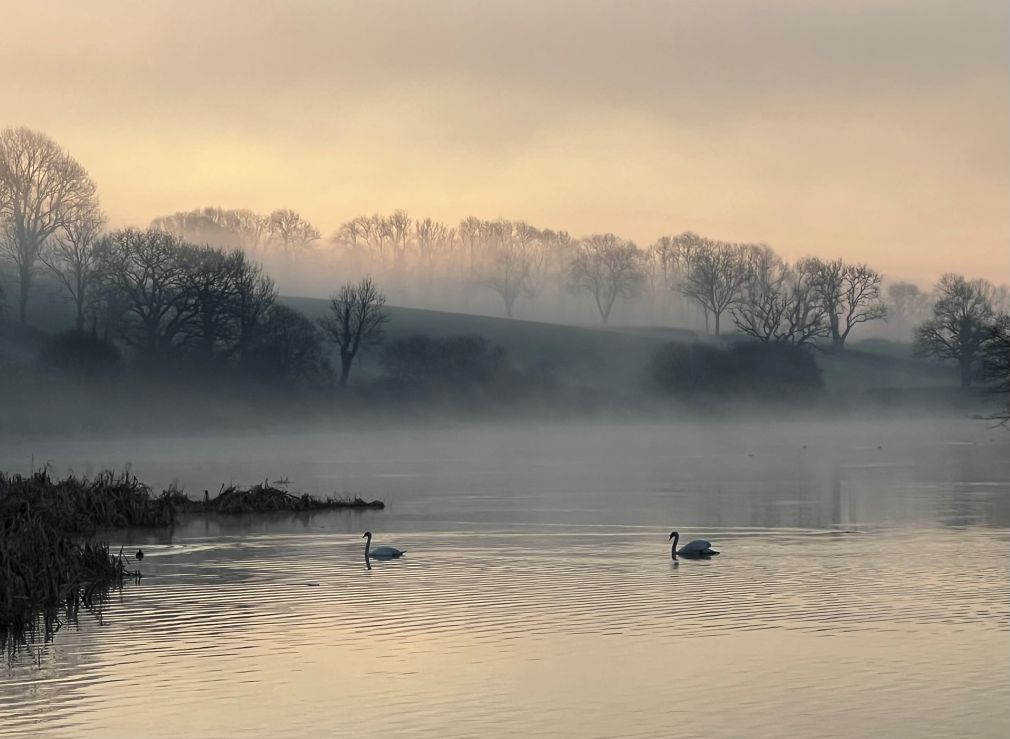
Broadwater Lake (near Moira) --by James Napier
James finished with some photos taken with his recently acquired Canon EOS R7 with tight focal length for close up botany shots approaching but not macro photography.
Fellow botanist Ian McNeill gave the vote of thanks to James for a really inspiring and well-illustrated talk.
The Chairperson reminded members they all had their mobile phones in their pocket and had received lots of tips how to use the them and to get out there, take lots of pictures and send them to himself or Alan Aitken for posting on the CWT website.
A number of our members purchased a copy of James' book "An Introduction to the Wildflowers of Northern Ireland"
Lecture summary by Ernie Hunter.