


 English
There was a large attendance including new members for our October meeting. Before introducing the speaker for the evening our chairperson Ernie Hunter enquired if anyone would like to do a short presentation for Members Night in December and to contact him if so. The speaker, Stephen McGuiness, an RSPB project worker at Glenwherry thanked Ernie for the invitation to speak on Europe’s largest wader, the curlew.
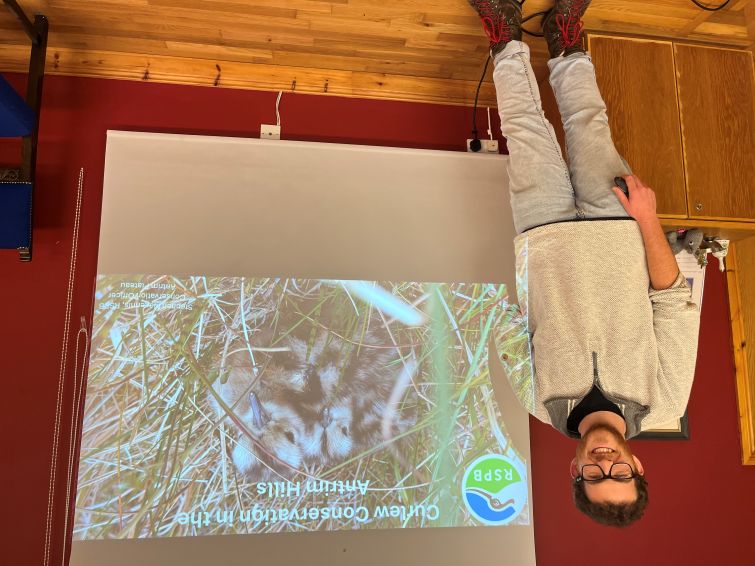
Stephen Magennis RSPB Conservation Officer Antrim Hills
The curlew is distinctive for having a long downward curved bill. They are long lived and only breed when 3 years old. So, it can be several years before it is realised that low chick productivity is seriously impacting the survival of the species. Once common they are now on the Red List with an estimate of 250 breeding pairs in Northern Ireland. Glenwheery situated between Ballymena and Larne is an upland plateau consisting of grassland, heath and blanket bog. It is a special protection area for hen harriers and merlins but not for waders even though it is one of the best sites in Northern Ireland for breeding curlews.
Curlews preferred habitat is marginal farmland which is wet rich grassland with a mixture of vegetation types and heights. Unfortunately, this type of land is now in decline through agricultural intensification such as drainage and reseeding, increase in number of silage cuts, increase in stock numbers, conifer planting and erection of windfarms which are all detrimental to the curlews’ survival. They are ground nesting and easy prey for predators like foxes and hooded crows which occupy the mid-way part in a food chain. Climate change also influences their numbers as does the dreaded bird flu.
Curlews are migratory and after breeding will congregate in groups on mud flats, marshes and nearby farmlands. Some will travel quite a distance and obviously the longer the route the higher the chance they will not survive the journey. Curlews from Scandinavia migrate here to escape the very cold weather in their countries which often leads to the misinterpretation that curlews in Northern Ireland are not in decline.
For the past twenty years the RSPB has concentrated on Glenwherry and although they do not own the land they are in partnership with about fifty of the local farmers. Under the environmental farm scheme (EFS) the farmers receive a five-year plan. They receive financial help and expert advice and in return they are not allowed to reseed or use fertilizers, silage cutting has to be delayed, predators culled and livestock levels restricted and cannot be grazed during the birds’ breeding period. In the last four years the Curlew LIFE Project has been established to improve their breeding habitat and to stabilize populations. This has led to 202 chicks successfully fledging.
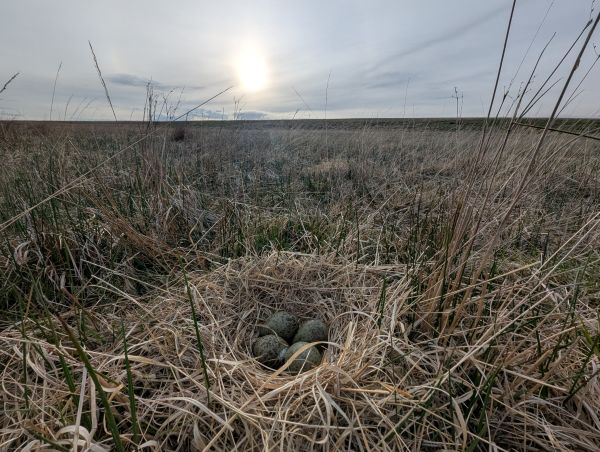
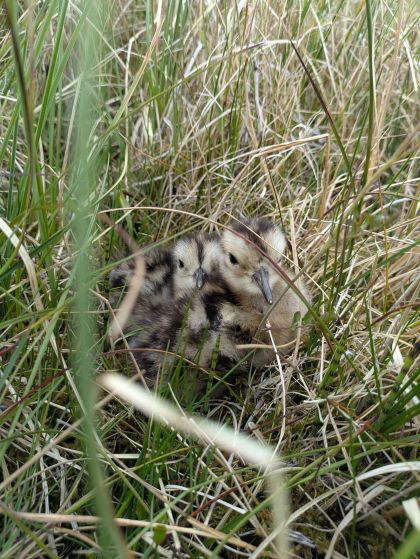
Curlew nests with eggs and chicks --images by Stephen Magennis
Farmers are asked to make habitat features such as scrapes which are small areas of land dug out to create or preserve wet pastures. Rushes are cut aiming for 30% rush cover. Trees are removed to remove perches for buzzards. Scrub removed to remove hiding places for predators. Scrapes are vital for the chicks which lack the long bill of their parent and therefore need soft ground to find insects and worms. Drains are reprofiled to remove steep sides, so chicks do not fall in. Curlews incubate their eggs for about 4 weeks and the young stay with their parents for another 4 weeks. Keeping a close watch on the nests is vital and cameras placed around the nest areas have been found to be very productive in reducing mortality rates. The building of fences consisting of 4 wooden posts with 9 strands of electric wiring around the nests have seen a 90% success rate in chicks’ survival. Candling the eggs is useful in not only determining if they are fertile but also in charting their different stages of development and thus estimating when they will hatch. Once hatched the chick is ringed with either coloured flags or rings placed on their legs. It has proven to be a good way in finding out where the chicks eventually settle. For example in one year three chicks successfully fledged; two remained in Northern Ireland and the third flew to Cornwall in England. Curlews are long lived and can live to the age of 30.
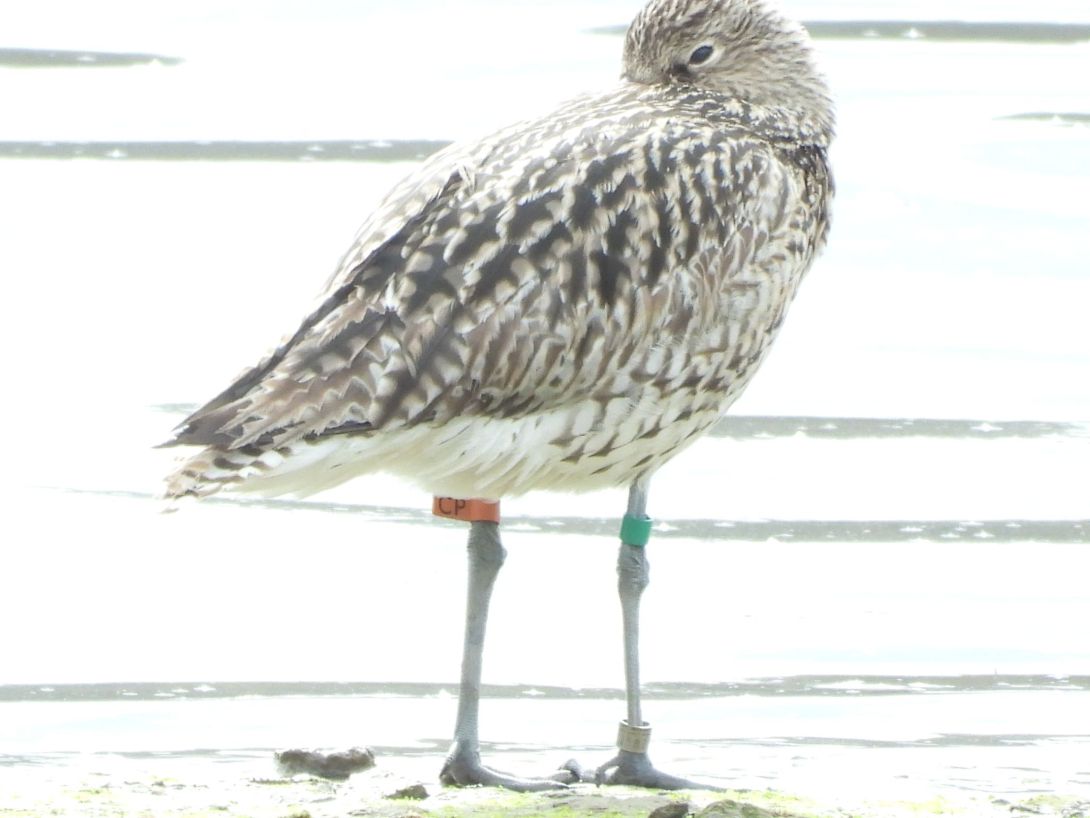
This 8 month old ringed juvenile turned up in Cornwall !
In June 2025 £40 million of Peace plus funding was awarded to help biodiversity, nature recovery and resilience. Some of this money will go towards helping priority species such as the curlew It will be of great benefit in recruiting more farmers to the scheme curlew LIFE which in 2025 will be known as Peace Plus by helping with land management, and financial aid. Twenty farmers so far have agreed to become involved.
After a question-and-answer session Claire Hassan gave the vote of thanks and this was followed by a light supper.
Lecture summary by Maureen Graham Secretary