


 English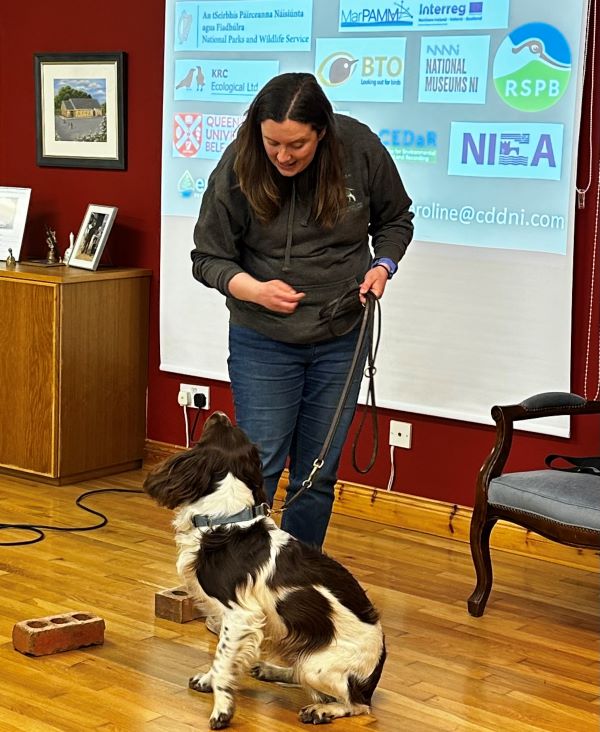
Caroline with one of her detection dogs
Dr Caroline Finlay the founder of Conservation Detection Dogs N.I was our last speaker of the season. Caroline has been working in conservation for over ten years studying many animals including Red Squirrels in Northern Ireland.
Dogs she said have an amazing sense of smell having 300 million scent receptors in their noses compared to humans with only 400. In other industries they have been used for detecting explosives, drugs and diseases such as Cancers and Parkinson’s disease but in conservation the use of dogs has been limited. Caroline believes passionately this should not be the case.
Detection dogs are specially trained to sniff out odours related to conservation. They are trained to give passive indications by freezing at the source providing the handler with a clear message that they have made a find. They never bark or touch whatever they are trained to locate so there is minimum disturbance The dogs can be used to detect live animals, carcasses, birds’ nests, chicks of birds nesting in burrows and diseases. They also can search areas quickly and can negotiate difficult terrain which humans would find difficult. Caroline cited many cases where detection dogs have proved their worth.
One such area is in the identification of diseases in animals. Squirrel Pox is a deadly virus of our native red squirrels. This virus is often carried by grey squirrels which rarely die from the disease. The dogs are trained to find dead and sick red squirrels and by early detection and the removal of the squirrels’ feeding stations and eradication of grey squirrels the spread of the virus can be controlled.
Wind turbines have always been a debatable issue. On the one hand renewable energy is necessary and beneficial but if inappropriately located, turbines can have a negative impact on wildlife. This is especially true regarding birds. Raptors such as buzzards, peregrine falcons and eagles can die or be injured through collision with turbines. Habitat changes in for example, the development of land-based wind farms usually require the addition of roads and infrastructure which may cause animals to leave the area. Turbines can affect bats especially migratory species through collision (because of the light from these devices, insects are attracted to them which in turn attracts the bats looking for food) and barotrauma (damage to tissues from air pressure changes) As the turbines are often situated in rough countryside dogs can move quickly and easily to detect the carcasses and body parts of birds and bats lying in the thick vegetation. It has been estimated that 80% of dogs compared with only 20% of humans are successful in locating dead animals affected by turbines (In Sweden scientists have found that black paint on the tips of turbine blades reduced avian fatalities by 70%)
Dogs are useful in seabird detection. Caroline gave the example of the Manx shearwater which migrates from Argentina in late February and March to breed in rabbit burrows on offshore UK islands. Two sites with Manx shearwaters were identified in Ireland, and it was hoped to do a survey on their numbers by using dogs to locate the hidden occupied burrows. Unfortunately, when this project was about to start in 2022 avian flu arrived and the islands have been off limits ever since. A study has been undertaken on Ramsey Island off Wales and the results are promising. Dogs were able to find the occupied burrows with minimal disturbance to the birds. Seabird monitoring and the ringing of seabird chicks is very important as seabirds are one of the most threatened groups of birds.
Caroline then mentioned biosecurity, the eradication of species detrimental to wildlife. The Great Saltee Island off Co Wexford is an important breeding ground with more than 220 bird species including fulmar, gannet, tern and razorbill. This has been granted the status of a special protection area to protect the bird habitat. A Rat Eradication Project was undertaken in 2020 and now the island is monitored regularly for the presence of rodents by using detection dogs. Caroline’s dog, a springer spaniel named Monty is trained in rodent detection. Rathlin Island this year will also be using detection dogs including Monty to locate rats and ferrets which are threatening the seabird colonies.
It’s not only animals which detection dogs can locate. The slender green feather moss lives on peat land. If there is any pollution, too much fertilizer or over grazing on the peat land the moss will disappear, so this plant is an important indicator of pollution. Dogs can be trained to distinguish by scent this moss from other mosses. In Finland they use dogs to look for the rare green shield moss.
Curlews are in decline. it has been estimated that 82% of breeding pairs of curlews has disappeared. If curlew nests containing eggs can be found in the long grasses then protective fences can be erected around the site preventing predators from destroying the eggs. In 2022 detection dogs started to be trained to detect these nests. Getxent tubes which absorb all odour molecules, in this case it was curlew egg odour, were used and applied to fake nests. When the dog smelt the odour, it stands still.
To demonstrate how effective dogs can be at finding curlew nests Caroline pitted one of her dogs against a curlew expert. The trail ran for 5 days, and the results showed that dogs were able to discover more nests than humans. In 2024 dogs will be used to find curlew nests in Glenwherry in Co Antrim. This has the largest breeding population in Northern Ireland. It is thought there are 37 curlew pairs across 8000 ha in this area. By using dogs instead of humans, it is hoped that the birds will not abandon their nests or send out alarm calls alerting predators to the vicinity.
The Ecology Detection Dogs Britain and Ireland Working Group are concerned with the fact that as anyone can train a dog to detect wildlife some type of legalisation will be necessary so that wildlife will not be harmed.
Caroline ended her talk with introducing us to Monty her detection dog who demonstrated his scent skills superably although he did also find Caroline’s store of doggie treats hidden in her bag!
Claire Hassan gave the vote of thanks, and everyone agreed that it was a very interesting and entertaining talk.
The AGM followed and tea and traybakes were served afterwards.
Carolines e mail is caroline@cddni.com
Summary of Caroline Finlay's talk written by Maureen Graham Hon Secretary