


 English
The first meeting of the new season opened with chairperson Ernie Hunter welcoming all attendees. He briefly mentioned our successful summer fieldtrips and congratulated committee member Claire Hassin on the birth of her baby girl and Edmund Slaine who has recently become a married man! Money from a grant from Mid Ulster Council which had been applied for went towards purchasing five bat detectors. The rest of the grant will be put towards buying a trail camera and a bird nest recorder. He also thanked Sophie and Sebastian Graham for donating a moth trap to the club.
He then introduced our speaker Dr Eimear Rooney. Eimear did her PhD on Raptors Ecology. The word raptor comes from Latin meaning to ‘take by force ‘There are two groups; the Falconiformes which includes hawks, falcons, eagles and vultures and the Strigiformes which are represented by the owls. The NI Raptor Study Group started in 1991 and in 2013 with the help of funding Eimear became Raptor Officer. She explained what was involved with this position such as coordinating volunteers, recording raptors and even climbing ladders to look at nests! Forming a database is a very important part of her job and information is gathered not only from volunteers but from members of the public. This information can be anything from reporting nest occupancy to breeding outcome of the nests found.
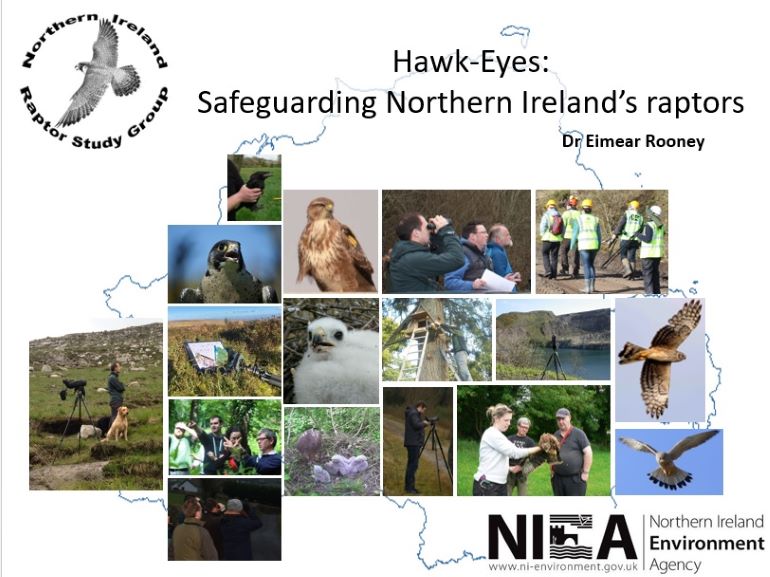
Eimear informed us that raptors are 50% in decline globally. In the 1900s many birds of prey became extinct in Ireland. Buzzard, goshawk, hobby and golden eagle were no longer to be found. Now we have 14 species in Northern Ireland. The list includes common buzzard, red kite, goshawk, hen harrier, marsh harrier, white tailed eagle, golden eagle, merlin, kestrel, hobby, peregrine falcon, osprey, barn owl and long eared owl. The honey buzzard and short eared owl have also been noted. Different birds of prey have different pressures to contend with. Some may suffer from habitat loss, others from disturbance, poisoning and even climate change. Eimear proceeded to tell us in more detail about some of the birds of prey she had mentioned.
The common buzzard has made a wonderful return. It reintroduced itself and numbers now stand at 3000 breeding pairs although the population once stood at 20,000 breeding pairs! It is on the green list category in the Birds of Conservation Concern. This green list means that the bird is regularly seen in Northern Ireland. It is a very adaptable large brownish bird which nests in high trees and keeps a very clean nest!
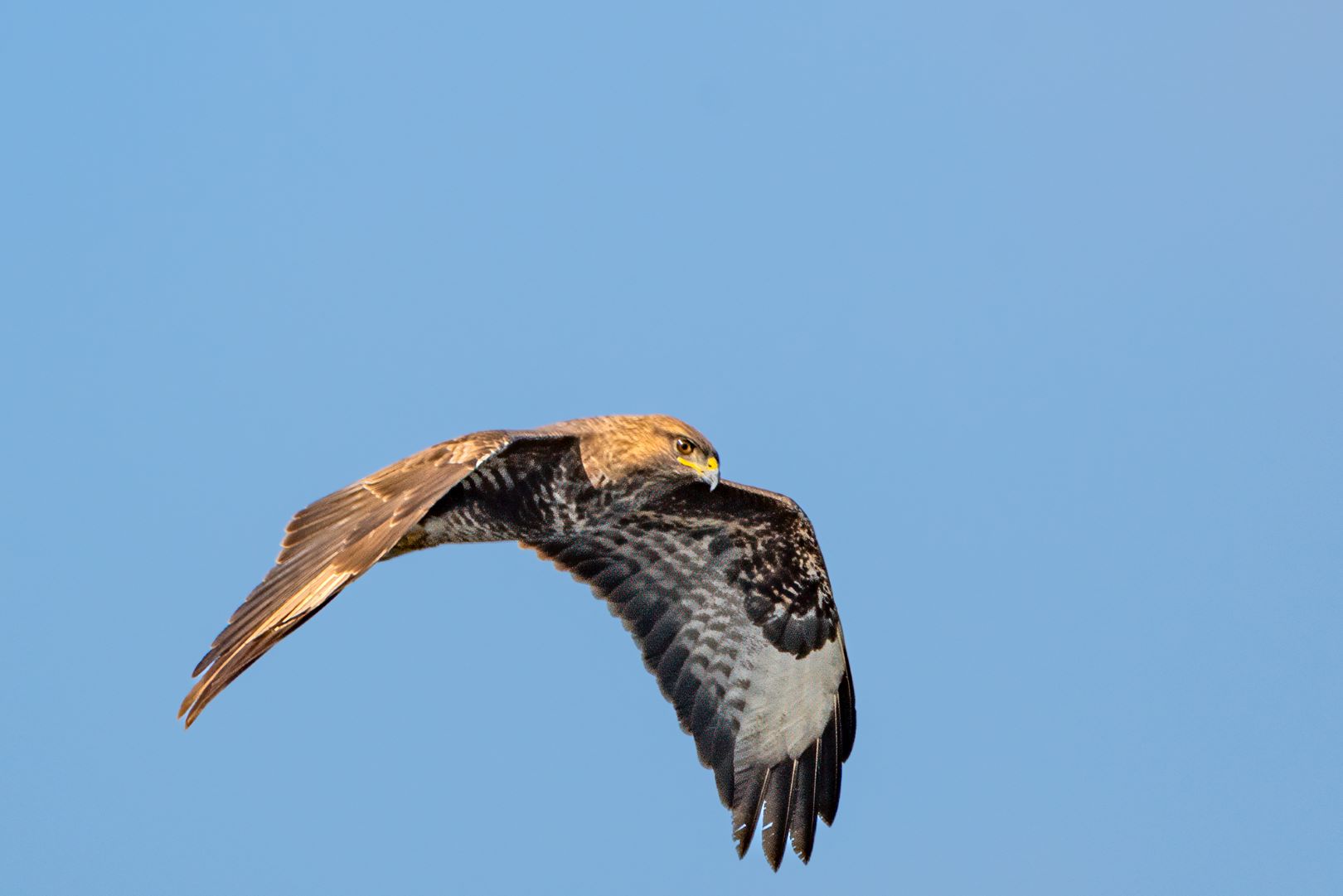
Buzzard (Photo by Thomas Campbell)
The Red kite is on the red list which can be classified into different groups from near threatened to critically endangered. 80 birds were introduced from Wales, and it is now estimated there are around 25- 30 breeding pairs in Northern Ireland. They are medium size birds and in flight resemble a gull but of course the fork tail is its most notable feature. Another interesting fact is they are communal birds. There are many different names for a group of red kites. Wakes and husks are a few. In Spring and Autumn, they can be seen together circling in the sky and in winter, flocks will seek secluded woodland to use as roosting sites. The Mourne Mountains and the Dromara Hills are two places they can be found. Like the buzzard they are opportunist feeders, eating invertebrates, rabbits, dead animals and roadkill. Scientists have discovered that they have a very long gut which means they can eat dead animals even a month-old with no ill effects! Their nest is very dirty with bits of decaying flesh littering it and the surroundings. Interestingly they will decorate their nests with white items, anything from tennis balls to babies’ vests! Stuffing from old toys has also been noticed in some nests and this has the potential of harming the chicks by becoming entangled around their legs. All kites over here are tagged so that more can be discovered about their behaviour and habits. Unfortunately, these birds are often persecuted. Forty-eight birds have so far been found dead; 13 had been poisoned and 3 shot. Eimear said It is very important that any recordings of these birds either alive or dead are reported to her group, and she urges members of our group to do so.
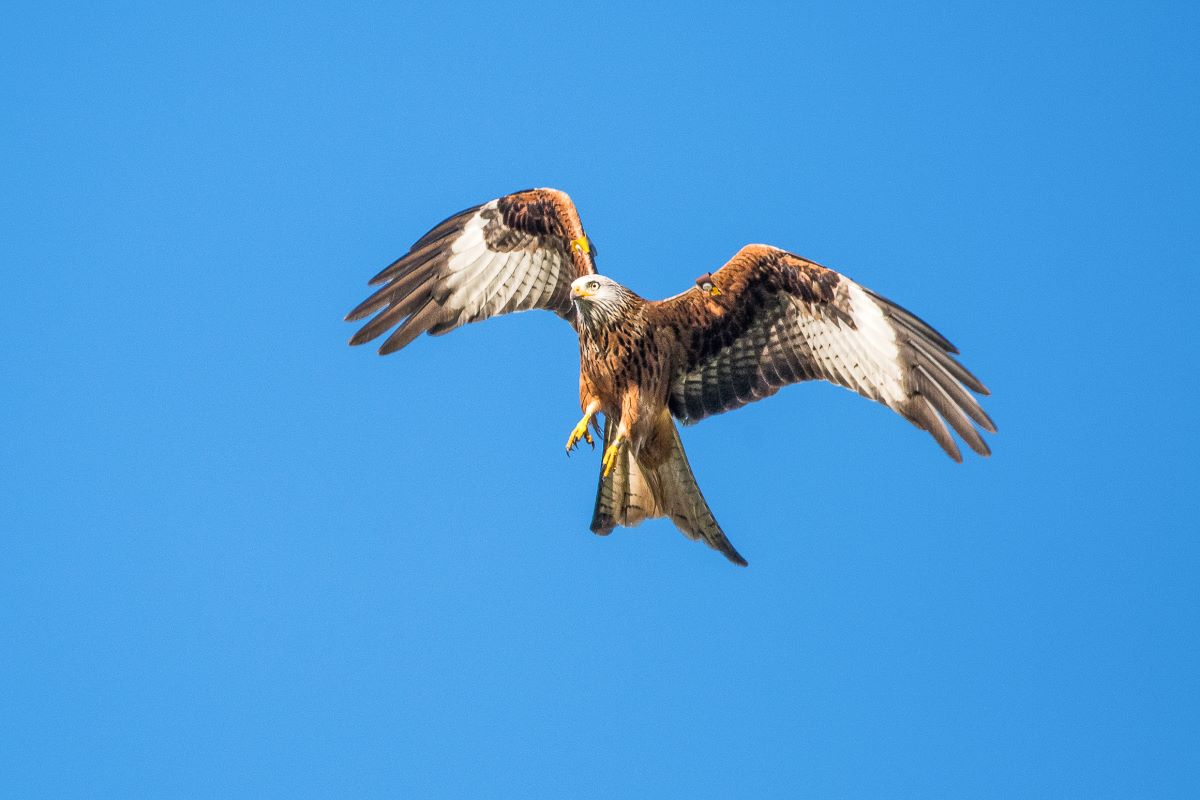
Red Kite (Photo by Thomas Campbell)
The Hen Harrier is a migratory species which is on the red list. There are 34 to 40 breeding pairs. In 2023 there were only 12 nests where the chicks were successfully reared. It is a bird which is declining globally. Why this is could be for many reasons. Pressures from habitat loss, disturbance of the nest site, predation, persecution, wildfires, turbine erection and wet weather, especially in July, all are detrimental to their nesting outcome. The female is brownish but it’s the grey plumage with black wing tips of the male which makes the most impact. They live in uplands, moorlands, shrubby areas and coastal marshes. The Antrim hills and Ballycastle are good places to see them and to watch their dramatic courtship ritual known as ‘sky dancing’.
Sparrowhawks are on the amber list. This means there are of concern but not yet critically endangered. This may change. Estimation is that we have 2000 breeding pairs but as sparrowhawks are not often reported this figure could be higher. They can be found everywhere from gardens and parks to woods and conifer forests. They are a very light bird which is lucky as their nest is very flimsy! Nests can be identified by splatters of their excreta resembling whitewash on the nest itself and on surrounding trees. Eimear said that although bird lovers may not embrace these raptors, as they often prey on the birds at bird tables, they nevertheless are wonderful creatures and as a top predator should be respected.
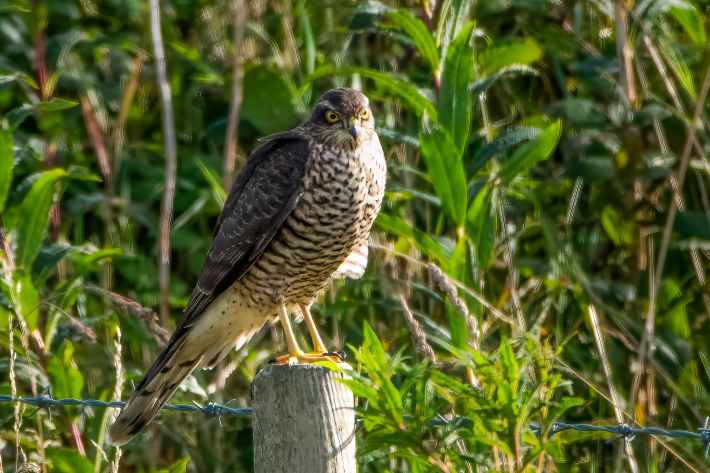
Female Sparrowhawk (Photo by Thomas Campbell)
Peregrine Falcons are on the green list. With 60-80 breeding pairs it is a species which is well recorded. They don’t build a nest rather they lay their eggs on a ‘scrape’ on a cliff face or on a tall building. Their main food is pigeons and as they also predate on racing pigeons this has led to persecution. Unfortunately, poisoned bait in the form of a live pigeon covered in poison is often used to kill these fascinating birds.
The Merlin is very small raptor. It is red listed in the UK and amber listed in Ireland. Now there are 40 breeding pairs, but it is thought to be on the decline in other parts of the UK. They nest on the ground but over here they nest in trees especially using crows’ nests. This could be because of lack of heather or perhaps the abundance of ground predators forces them to retreat to the trees. The merlin is another bird which is under reported.
Once common the Kestrel is on the red list. There are 1000 breeding pairs, and they nest in tree hollows and in old crows’ nests. The decline in their numbers may be due to many factors from habitat loss due to intensive agriculture, lack of prey such as insects, ingesting poisoned rodents and of course the use of agricultural chemicals.
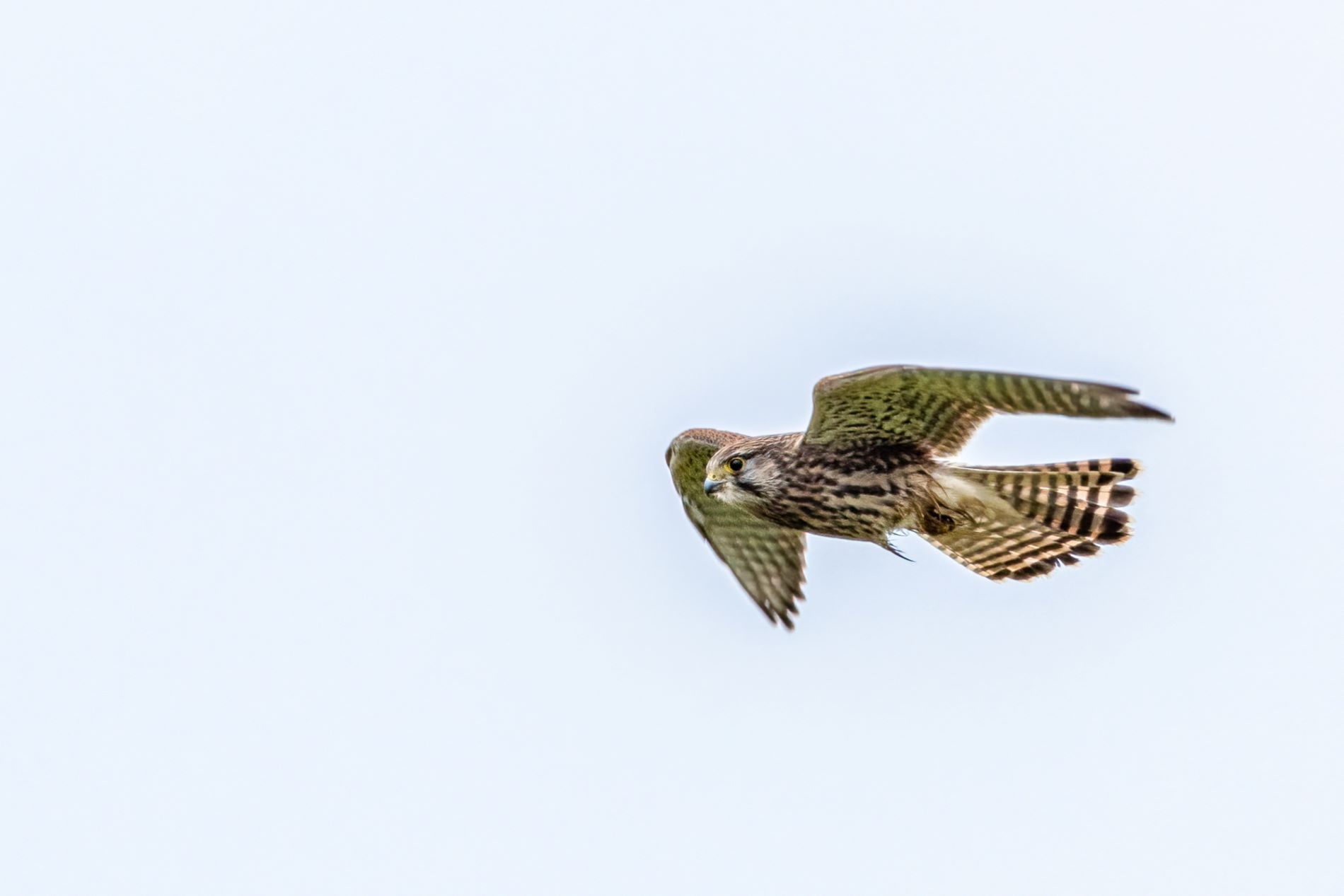
Female Kestrel (Photo by Thomas Campbell)
The Goshawk is a large, heavy bird and is on the amber list. There are 0 to 10 breeding pairs. They prefer very old plantations such as the ones found in Fermanagh. A very secretive bird and again very unrecorded they will prey on duck, pheasant, rabbit and even kill and eat buzzards.
The Golden eagle is on the red list with 5 to 10 breeding pairs. A total of 60 were introduced and since 2007 twenty Irish born golden eagle chicks have fledged in Donegal. They can be watched soaring high in the sky in upland areas and remote glens. Food consists of a wide range of medium sized birds and mammals. Grouse and rabbits are often favoured. Eimear is hopeful that their numbers will increase.
The White-tailed eagle or sea eagle is our largest bird of prey and is on the red list with 8 to 10 breeding pairs. They inhabit coastlines and can be seen inland near lakes. Antrim and Fermanagh are good places to spot them. They like to perch on old large trees or on cliffs and are known to remain still for many hours. They seem to have a definite route travelling from the Antrim coast to Rathlin Island to Mull of Kintyre in Scotland. They eat largely fish, but also prey on wildfowl, shorebirds and small mammals. Carrion is an important part of their diet especially during winter. Again, Eimear thinks the population will increase.
Eimear mentioned birds of prey which rarely breed or over winter here. The birds she cited are Marsh harrier, Honey buzzard, Osprey, the nomadic Short eared owl, Snowy owl and the Hobby.
She added that to record birds of prey there are a few things one should note. Firstly, direct nesting signs such as watching to see if the bird is carrying prey or sticks to the nest, if the bird is alarm calling, if the female is moulting—they will do this after they lay eggs---and of course watching for signs of territorial aggression. Indirect nesting signs are plucking posts, prey remains, bits of fluff around and on the nest and regurgitated pellets. Peregrine falcon pellets will all be feathers while buzzards will be feathers and bones.
By developing a database Eimear can meet with relevant authorities to advise them on things like habitat loss. She mentioned approaching farmers and landowners who have birds of prey on their land and explaining to them how disturbance can affect the birds such as failure of the adults to lay, adults abandoning eggs or chicks, predators been alerted to the nesting site, eggs or chicks been trampled on if they are ground nesters or falling out of the nest if they are tree dwellers.
Eimear also explained why birds of prey are persecuted. Some people think they kill pets and newspaper scares with headlines ‘Child attacked by a buzzard’ does not help. Gamekeepers and others will protect their game birds by shooting or poisoning raptors. Between 2009 and 2023, 87 birds were identified using scientific methods to have been killed by poison. Eimear is in partnership with Action Against Wildlife Crime to ban the possession of dangerous pesticides. Satellite tagging buzzards and red kites will help in keeping the birds under surveillance as well as providing important information on their behaviour.
It’s illegal to damage nests of eagle, barn owl, peregrine falcon and it’s illegal to set in position traps and poison. They are protected by the Wildlife order 1985. Anyone found ignoring these laws can be fined £5000 and even given a 6-month custodial sentence.
A question-and-answer session was followed by a vote of thanks with tea and traybakes to finish a very interesting first lecture.
Lecture Report by Maureen Graham Hon Secretary with photos from Thomas Campbell