


 English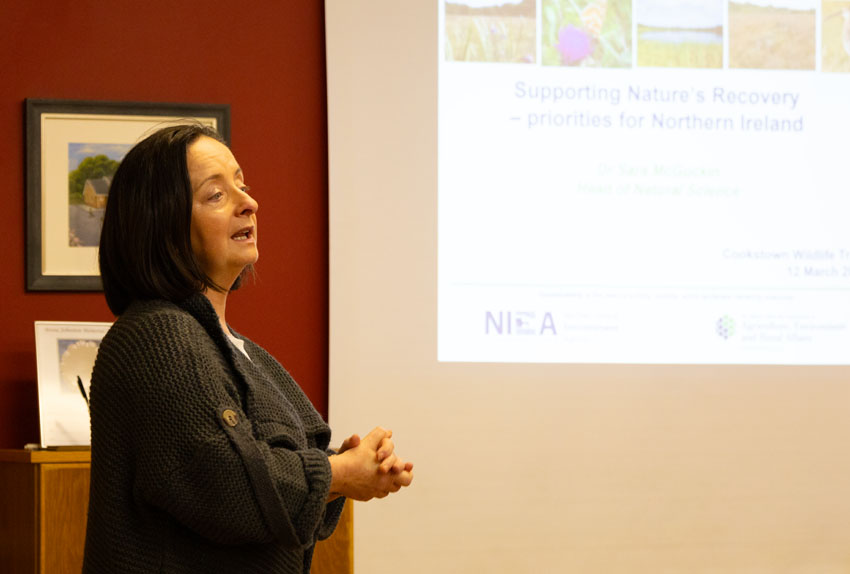
Our speaker for 12th March 2024 was Dr Sara McGuckin, Head of Natural Science at Northern Ireland Environment Agency. The agency’s main purpose is to protect and enhance Northern Ireland’s environment. Sara spoke on biodiversity which concerns the variety of all living things and their interactions, and how important they are for the processes that support life on Earth. Without a wide range of animals, plants and microorganisms we cannot have healthy ecosystems. Northern Ireland has special biodiversity as it is part of the Atlantic biogeographic region with specialist habitats and species associated with mild winters and cool summers.
The Agency has established five key priorities:-
1.Working towards a compliant regulated industry.
2. Delivering freshwater environment at ‘good status.’
3.Tackling waste crime.
4. Supporting good habitat, earth science and landscape quality and enhancing species abundance and diversity.
5. Promotion of environmentally sustainable development, infrastructure and access to good green and blue spaces.
However, Sara pointed out that despite having a whole suite of international agreements protecting nature in Northern Ireland, nature is in serious decline.
11% of NI species assessed are threatened with extinction.
56% of native plant species have declined in range and abundance.
26% of our bird species are now on the Red List.(e.g. Breeding Curlew declined by 82% from 1987-2013)
Butterfly indicator species have declined by 17% since 2006.
12% of NI is covered by peatland habitat but 86% of this is in a degraded condition.
40% of flora and fauna in our ASSI’s are in unfavourable condition.
The decline in species is due to a combination of agricultural practices, air pollution, water pollution, developments, invasive species, climate change and commercial fishing. It’s important to address these and Sara is hopeful that with the Executive now in operation action can be undertaken to protect our environment. Lough Neagh and Lough Beg are protected and are priority habitats, The Upper Ballinderry is also protected as it has freshwater pearl mussels. These are unique and genetically distinct from all the other mussel populations in Northern Irish rivers. Without help they will become extinct. Sara mentioned the important work of Ballinderry Rivers Trust.
Currently 8.9% of our land is protected.
Target is to protect 30% by 2030 (The 30x30 Plan). It is hoped the decline in nature will then reach a nadir by 2030 and NI will then start becoming nature positive again.
There are nine actions which must be undertaken. One of these is to show evidence to planners that a site must be protected. Another action is to make sure that government departments don't automatically go for hard engineering rather than soft engineering. Hard engineering is artificial man-made structures such as sea walls used to protect coastlines against erosion. Soft engineering is more naturally managed, is less expensive and is less harmful to both humans and animals. For the past eight years the agency has been working on a map of Northern Ireland environmental projects. One of these involves monitoring the impact of ammonia on habitats especially peatlands like our local Curran Bog.
Our speaker says it is crucial to build up evidence to support findings and this is where the public such as wildlife groups and even schools can help by monitoring and recording plants such as orchids, insects like bumblebees and butterflies, birds like owls and mammals like bats and hedgehogs. Results can then be submitted to CEDaR online recording. Sara said we are fortunate in NI to have a single centralised recording department in CEDaR unlike the multiple recording centres in Britain. She also reassured us that ALL data submitted to CEDaR is used.
The presentation was followed by questions from our members. Lough Neagh and its toxic algae bloom (already two confirmed reports this year) was the main topic with members asking what is causing it and how this problem could be eradicated.
To find out more on Sara and the Northern Ireland Environmental Agency log on to www.daera-ni.gov.uk
Lecture report by Maureen Graham (Hon Secretary)