


 English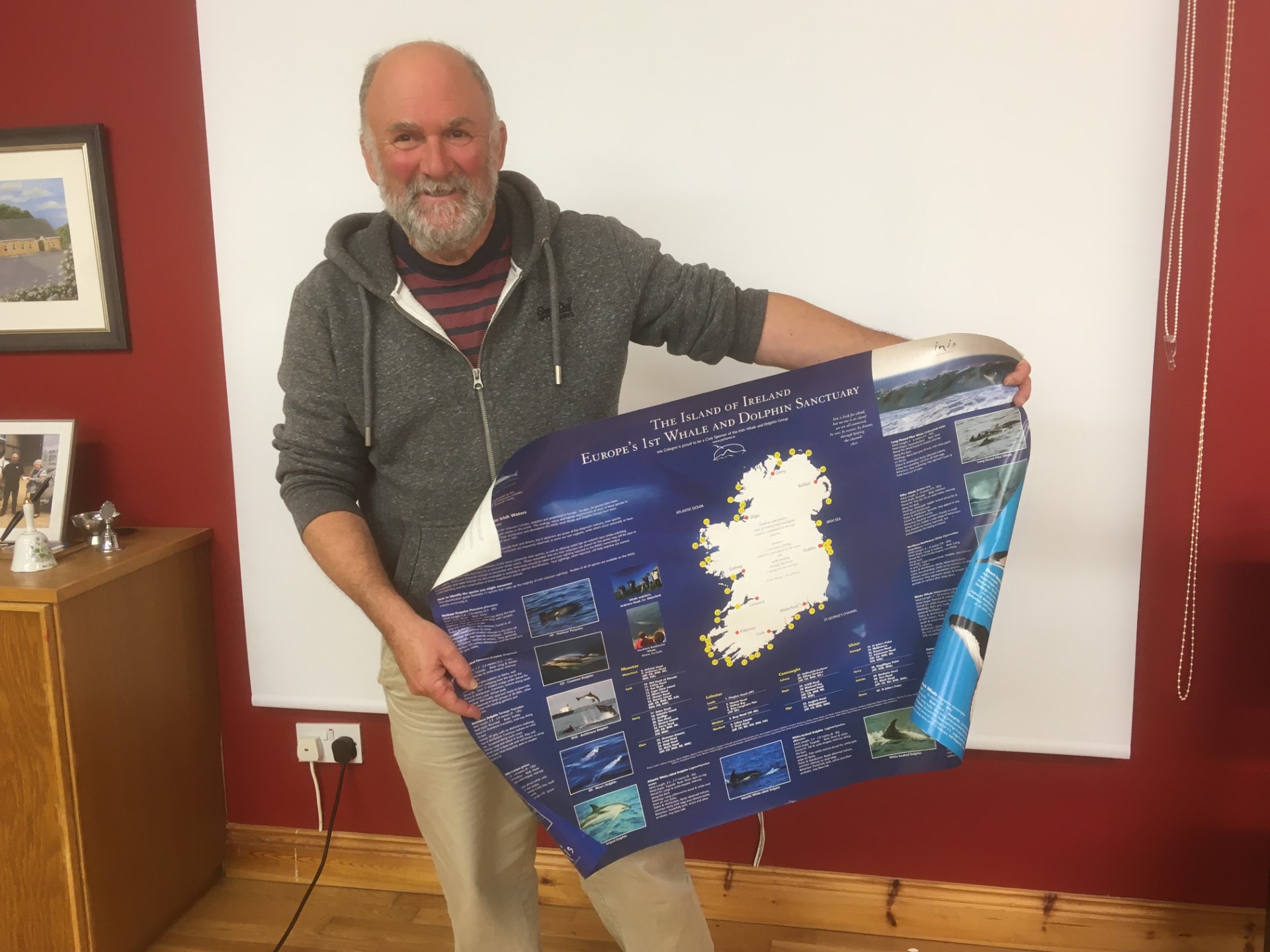
0n 13th February 2024 Ian Enlander, from the Irish Whales and Dolphin Group, gave a very enlightening talk on these animals. This group was formed in 1990 to conserve and develop an understanding of whales, dolphins and porpoises in Irish waters. They campaigned for Irish territorial waters to become a sanctuary for them and in 1991 Irish waters were designated as Europe’s first whale and dolphin sanctuary. Charles Haughey, the Taoiseach was a keen follower of this group and after his death in 1992 his family donated his boat to the group.
To date 26 species have been recorded in Ireland and as there are 94 species globally Ian explained that the number recorded in Ireland represents a sizable proportion of the global figures.
Whales, dolphins and porpoises are classified as cetacea and within this are two suborders, baleen whales and toothed whales
The toothed whales include dolphins, killer whales and porpoises. Some like the Yangstze river dolphin have become extinct while the Vaquitas, a species of porpoise, are down to no more than twenty.
Data has been collected and has shown that the most common cetacean in Irish waters is the Harbour Porpoise. It is 1.8 metres long with a stumpy dorsal fin. With a dark top and pale underside, it is well camouflaged. As it is so small it has to spend a lot of time hunting so that it can get enough food to maintain its energy level. It has been estimated that they can catch 550 tiny fish like sprat and whitebait in an hour. They have a 90% success rate as long as there are not disturbed. Unfortunately, problems like PCB, a manufactured chemical used in industrial and consumer products have weakened their immune system and reduced their breeding success. This, Ian explained, is despite the fact that PCB was banned in the UK over three decades ago. It is thought they breed in Tunns Bank, Magilligan. Biologists have now definitely found evidence that grey seals hunt and kill harbour porpoises.
The second most common cetacea in Ireland is the bottlenose dolphin. It has a larger and differently shaped dorsal fin than the porpoise. Its average length is 3.8 metres, although large males can reach 4.5 metres. Their pods consist of an extended family and can be anything from 10 to over a 100. They can often be seen jumping out of the water and embarking in other acrobatic displays especially along the Antrim coast road. in Ireland It is said that there are 4 populations; the Shannon ones who rarely leave the area, the inshore population of West Scotland which can number 300, the Cardigan Bay group, and the Isle of Man and Antrim Coast pods. These dolphins have been found to attack harbour porpoises. The reason is unclear. Porpicide is the name given to this behaviour. It could be young males practicing their killing techniques. Other theories have included misdirected infanticide. Scientists believe that cetacean might be doing what lions do when they kill young cubs so they can mate with their mothers and remove competition.
The common dolphin is uncommon here. Like the bottlenose it loves doing acrobatics, but it differs in size as it is only 2.7 metres in length. It travels in super pods. A super pod of 10,000 has been observed. They can be found around Castlerock and Rathlin Island
The killer whale is 7.9 metres long and can be distinguished by its large dorsal fin which is about 2 metres. The females have smaller and differently shaped fins. Ian says there appears to be two distinct groups. The transcient are smaller groups and they eat seals and other whales. Other groups are called home range. They are in larger groups and feed on fish and may be seen in Vancouver. Both have matriarchs and females can live to 100 years and males 40 to 50 years.
The Sperm whale is rare in Ireland. It Is 18-20 metres long and are found around the west coast. They are extremely hard to see as their sound will travel for miles. There is justification in saying that these animals may live to 200 years old.
Baleen whales have no teeth. Instead, they have baleen plates made from keratin. The second smallest baleen whales are the Minke whales. They have pleated skin under their chin which allows the mouth to open really wide. The tongue is used to block off the airways; the pleats expand, and the tongue is then used as a hydraulic ram to force water out. Only recently has the minke whale come back. Other species seen off Ireland are the Sei whale and the blue whale, which is a massive 39 metres long. The humpback whale has long narrow flippers which are scalloped on the forward edge.
Baleen whales are food dependant on sprats. Overfishing for sprats threatens all marine wildlife and not just these whales.
Ian finished his talk with a plea for volunteers to help with conducting a Heron census around different local areas. Our chairperson to be contacted for more details.
The Vote of Thanks was given, and this was followed by tea.
Summary of Ian Enlander’s talk by Maureen Graham
.