


 English
Our speaker for our November meeting was Ryan Boyle, an ecologist and Chairperson of the Northern Ireland Amphibian and Reptile Group. (NIARG. for short). Founded in April 2020 NIARG is based in Belfast and focuses on Northern Ireland’s native reptiles and amphibians. The group hope to start building relationships with local institutes and educational bodies to promote awareness and improve the current recording of newts, lizards and frogs.
The collective name for amphibians and reptiles is herps which comes from the Greek word ‘crawling animal ‘There are four native herp species in Ireland: the Common frog, the Smooth newt, the Common lizard and the Natterjack toad. In Northern Ireland there are only three species as the Natterjack toad is absent.
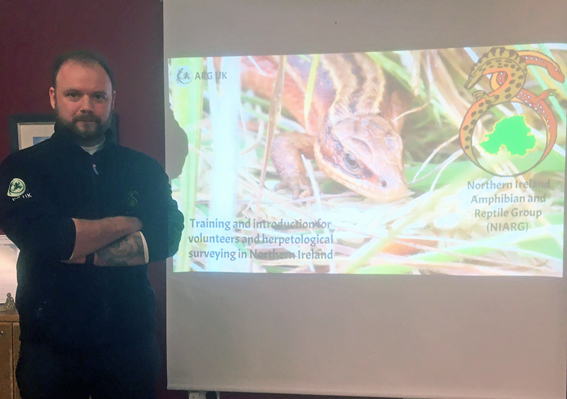
Ryan Boyle from the Northern Ireland Amphibian and Reptile Group
Ryan spoke on the Common frog first. These animals emerge from hibernation in late February. They can be seen during the day as well as night and can be found in every habitat including gardens, meadows, woodland, lake lands and even mountains. Their colour and pattern vary. For instance, some frogs are quite yellow with pronounced spots while others appear a darkish brown with no noticeable markings. Frogs are carnivorous and survive on a diet of invertebrates, worms, slugs and even smaller frogs and newts. They are especially vocal during the breeding season when males will croak to attract a mate. Once a partner has been found, the frog will grasp the female in a mating behaviour known as amplexus. She will lay one clump of frog spawn consisting of approximately 2000 eggs. These are laid in ponds but unusual places like tyre tracks can sometimes be used! Frogs are at the bottom of the food chain and are therefore important to the overall food chain. They are known as a keystone species by eating a variety of insects and small animals they keep everything in harmony. Predators that attack them are animals such as ducks, crows, kingfishers, pike, bass and foxes and badgers.
Frogs are protected by the Wildlife and Countryside Act 1981 which offers basic protection although unfortunately no one can be prosecuted for harming them.
The Smooth Newt or Common Newt is Ireland’s only tailed amphibian. As it is rarely seen numbers are not known. It tends to come out of hibernation in March and goes from having a terrestrial life to an aquatic one. Interestingly they always go back to the same pond they were born into to breed. Their habitat is mainly moorlands, wetlands and garden ponds. They are mostly active at night and will feed on insects and even frog spawn. They are sexual dimorphic as both sexes are dark above with a striking orange, black spotted belly. This colouration is most prominent during the breeding season when the male also develops a crest along its back. On their return to the water, they begin an elaborate courtship ritual, the males performing a courtship dance to woo females who can lay as many as 300 individual eggs in vegetation around the edges of ponds. The young newts emerge during the summer and are called efts. Later in the year newts leave their ponds and spend the winter hibernating under logs and stones. They are predated on by many animals including herons, foxes, kingfishers, rats and large frog tadpoles. They are protected under article 1 of Wildlife (Northern Ireland) order 1985 and a licence is required to study them. Our chairperson told an amusing story about a colloquial name for the newt, the “Mankeeper.” Several other of our members had also heard of this name. The story goes that if a person falls asleep beside a pond a newt will creep down the person’s throat and live as a parasite where eventually a brood of young newts will hatch. The only cure is to eat salty bacon and lie close to water where after a few minutes the thirsty newts will move all the way up to the persons mouth and slide out into the water.
Ryan asserted that unlike what most people think, Northern Ireland is home to a lizard. It is the Common Lizard, also known as the Viviparous lizard These lively lizards can be seen across many habitats including heathland, moorland, grassland and woodland. They like to bask in sunny spots and can be found in the Mournes, Slievenacloy Nature Reserve, Cave Hill and may even live in other locations including the Sperrin Mountains. More surveys are needed to confirm this. Active by day because they need heat to raise their temperature, they are unusual among reptiles as they incubate eggs inside their body and give birth to live young. Adults emerge from hibernation in spring, mating is in April and three to eleven young are produced in July. The female is browner than the male and has a striped back while the male has a flecked pattern on their back and a brighter orange spotted underbelly. Like frogs their colouration can vary from dark to light brown. The lizards are completely terrestrial. They do hibernate from October to March but can on occasions be observed out in the open in colder months. They are one of the coldest tolerant reptiles. It is wet weather rather than cold which causes fatalities. Lizards are insectivores and consume a large quantity of spiders and other small insects. If threatened by a predator they shed their still moving tail to distract the attacker They are heavily protected and listed as a UK priority species. Their decline has a lot to do with habitat loss and the conversion of lowland habitat to farmland and the loss of upland heath and coastal dunes. Ryan said that any Common lizard sightings should be reported to NIARG or ARG.UK.
Survey techniques for studying these animals vary. In newts it consists of nighttime searches, egg counts and netting. With lizards’ visual observation and laying down reptile nets are commonly used. Frogs are easier to research as they can be seen during the day and night. Visual recognition is used, as well as spawn counting and nighttime searches. A licence must be obtained to study newts and lizards. The forms can be obtained online. When undertaking surveys, it is important to follow health and safety rules like bringing an accomplice with you, having a phone and wearing the correct clothing and footwear.
Ryan finished his talk by giving some examples of alien herps species which are now resident in Northern Ireland. He says the most important ‘alien’ to eradicate is the Alpine Newt. Scientists have warned of its detrimental impact on the local biodiversity as it competes with the smooth newt for food. Its appearance is like our native common newt but differs in having more colour with no black spots on its throat or underbelly. Originally from continental Europe it arrived in Northern Ireland through the pet trade. Some were released into the wild where they quickly adapted to our mild winters. And as they reproduce very quickly their numbers soon increased. They are also carriers of chytridiomycosis, a fungus, which attacks the skin of frogs, toads and newts. This is a disease caused by 2 pathogenic chytrid fungi. These are known as bd and bsal. So far two populations of Alpine Newts have been discovered in Northern Ireland, one group was found in a forest and another smaller group near the coast. When captured some are kept alive for study purposes while others are destroyed. Ryan emphasized the importance for any sightings to be notified to authorities.
The Red Eared Terrapin is also another victim of the pet trade and can now be spotted in some of Northern Ireland’s ponds and lakes. They do not pose a threat as usually they are released into the wild singly and therefore will not reproduce.
Slow worms are legless lizards and one of the spots they have been discovered in is South Tyrone. They are usually escapees and are completely harmless.
The evening ended with questions. Mike McGrath gave the Vote of Thanks.
Lecture Report written by Maureen Graham Honorary Secretary