


 English
On Tuesday 10th October 2023 Daniel McAfee, Chairman of the Glens Red Squirrel group gave a very informative and entertaining talk to Cookstown Wildlife Trust on the native Red Squirrel. Northern Ireland has 15 Red Squirrel volunteer groups. Formed in 2008, Glens Red Squirrel group works in conjunction with other squirrel groups, other organisations and also with local councils. Their aims are to protect and to help maintain the population of Red Squirrels in the Glens of Antrim , to conserve Red Squirrels by educating and raising public awareness of their plight and to educate and encourage young people into conservation To do this they have organised safari walks, given talks to many different groups, visited schools and attended festivals and fairs They were the first group to “think ahead “ by planting trees and planning for the future of the Red Squirrel. Daniel also stated that they are involved in trapping and releasing Red Squirrels into other suitable areas. The traps used to do this are live traps. The Grey Squirrels are also trapped by live traps but are dispatched either by a sharp blow to the head or by shooting. Glens Squirrel Group are not an advocate of shooting them in the field as it may not be possible to fire a fatal shot resulting in injuries and painful death to the animal and inadvertently spreading Squirrel pox. Glenarrif Forest, Ballypatrick, Glenarm, Cushendun and Craigagh Wood all have been designated as “feeder sites” where feeding tables are placed and then monitored for the presence of Red and Grey Squirrels.
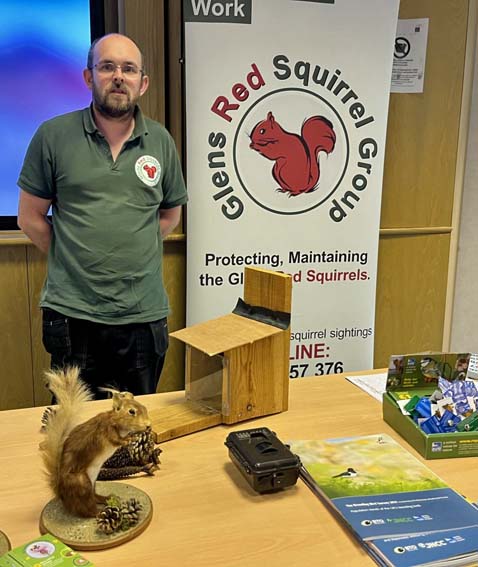
Daniel McAfee, Chairman of the Glens Red Squirrel group talking at CWLT
Daniel then talked on the difference between the Grey and Red Squirrels. In 1911, 12 Grey Squirrels were introduced to Castle Forbes in Longford as a wedding present! These subsequently escaped. Their offspring now occupy 80% of Ireland. They can live where there are few trees which is why they can inhabit towns and cities. Red Squirrels inhabit both deciduous and coniferous woods They are a reddish colour although this can vary from a light red to a darkish brown. The bigger Grey Squirrel also shows different colour variation and can even be reddish like the Red Squirrel. One of the best ways to distinguish them is by the presence of ear tufts in the “Reds” although this is not always reliable as their tufts get smaller during the winter. Grey Squirrels never have ear tufts and have what is called a” halo effect” on their tail. The tail has white tips, and these combine to create this distinctive effect. Greys also have a stronger digestive system than the reds. They can eat a vast number of seeds and nuts and have a habit of burying surplus seeds and nuts that are not ripe and will not germinate which results in less food for the Red Squirrels. Both species will eat birds’ eggs and chicks. It has been discovered that the Grey Squirrel will also “farm” which means if they find a bird’s nest for instance, they will not eat all the chicks at once. Rather they will eat one and then keep on coming back to the nest to eat the chicks at their different stages of development. The Grey Squirrels also love stripping the bark from trees. The reason so far is unknown. Red Squirrels favourite food are larch cones which they nibble, leaving what looks like an apple core behind. Both squirrels have 5 toes and 4 fingers and a vestige of a thumb. They sleep in a drey which is round and made from twigs, lined with moss and grass. There have three types of dreys. A winter one, a summer one and a breeding one. The female will build breeding dreys and she will construct 8 of them This means that when one nest is dirty and riddled with parasites, she will move her kits to a clean one. The male has an easy life as he does not help to build a drey or in the rearing of the kits. Courtship is termed a “chase” One female will be by chased by many males. The victorious male is the one who gets to her first! She will often have kits from different fathers. The Grey Squirrel has 3 litters while the Red Squirrel has 2. However due to climate change the Red Squirrels are now often having 3 litters. Probably the Grey Squirrels are having even more. Red Squirrels can live to 3-5 years and Grey Squirrels to 7- 10 years.
The biggest challenge to the Red Squirrel from the Grey Squirrel is the transmission of Squirrel Pox. Grey Squirrels are not affected by it as they have developed immunity to the virus. Red Squirrels however have not. Despite having still, a good appetite the affected Red Squirrel will die within 3 to 15 days. Twenty minutes after they die fleas and other ectoparasites leave the Squirrel and seek out a living replacement thus carrying the virus from an infected animal to an uninfected one. Not all Grey Squirrels have the virus, but they do have the potential to carry it and spread it through urine and faeces. It can even be transferred by contaminated feeders. Unlike what many people think Pine Martens will kill Red Squirrels. Scientists have discovered that when Pine Martens are living in the same area, the Red Squirrels will build their dreys on spindly branches and not against trunks of trees or in a hole in a tree. This is probably a safety mechanism as the heavier Pine Marten will not venture on to branches that could break. Cars and cats are other potential threats to the Red Squirrel.
Daniel ended his talk by taking questions from the floor. Anne Walls gave the vote of thanks.
Report written by Maureen Graham Honorary Secretary