


 English
Eight of us visited Donna Rainey’s wildflower meadow near Dunloy. We were met and led by Donna and her son James.
It was a special occasion on two counts. Firstly, we congratulated Donna on her recent award of an Honorary Doctorate by the University of Ulster for outstanding ecological work. Secondly, Saturday 5th July was International Meadow Day also known as National Meadow Day in the UK.
When we arrived lots of swallows and house martins wheeling about above the farmyard—they are nesting in the farm shed.
The lawn at the side of the farmhouse has been left uncut and lots of Yellow-rattle and Devil’s-bit Scabious were evident.
Donna took over the management of a five-acre field ten years ago. At that stage it was a field of barley under sown with ryegrass. Every year for nine years she has had the field cut for haylage late in the summer. No slurry or any other fertiliser applied so with successive mowing the field was gradually denutrified. They pulled the Ragwort out of the sward by hand. Initially there were a lot of docks which favour nutrient rich soil. They cut off the flower heads from the docks and year by year their numbers have decreased as the nutrient levels have fallen. Donna also pushed a sower over parts of the field distributing Yellow-rattle seed which germinates better if exposed to frost. She also plug-planted some Ragged-robin, Devil’s-bit scabious and a few Field Scabious.
Last year they stopped their annual cutting for haylage and instead grazed with Hereford and long-horn cattle and later ponies. Donna explained that cattle are best for a wildflower meadow as they graze non selectively and poach the ground helping wildflowers to set seed. Sheep are not helpful as they selectively graze the wildflowers in preference to grass and pat the ground flat and compact it such that wildlflower seed cannot set.
There was initially a succession of different plants as the ground denutrified eg early on Yorkshire-fog came in as the ryegrass subsided. Then Oval Sedge came in the early years.
However, the field is now spectacular. Big areas of Common Knapweed when in seed attracts flocks of Goldfinches as well as Bullfinches. There were big areas of Bird’s-foot-trefoil, Eyebright, Selfheal, Red Clover, Hogweed, Plantains, rushes, Oval Sedge, Cat’s-ear, Common Mouse-ear and dozens and dozens of Common spotted-orchids.
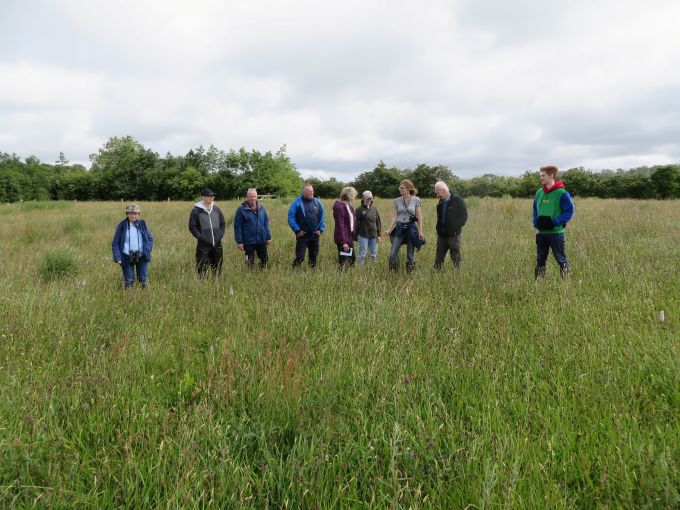
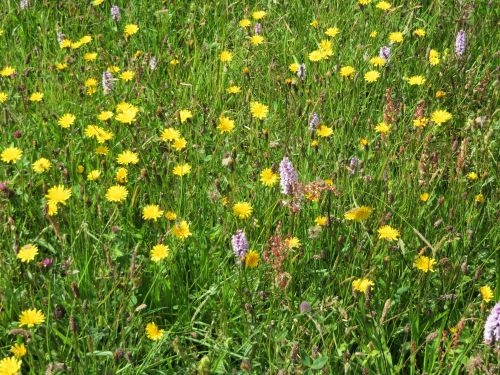
Donna showing us her wildflower meadow
James explained that orchids only grow in ground with low nutrient levels and orchid seed will only germinate and grow in the presence of a symbiotic fungus which supplies carbon and other elements. In nutrient rich soil other fungi predominate which do not have the same benefit to the orchid hence the orchid seed will not germinate in rich soil! Common spotted-orchids came in first. James expects that through time these will decrease and be replaced by Butterfly orchids.
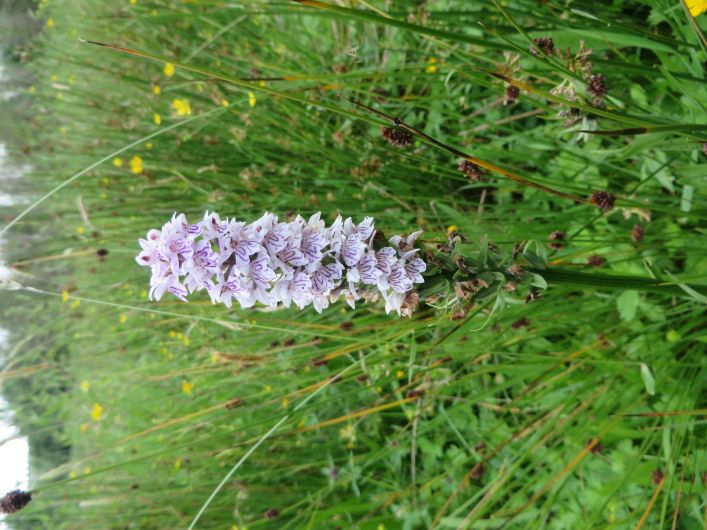
Common-spotted orchid
Donna explained that nine years ago she had replanted a boundary hedge with native species. This has really taken off. A group of nature friendly farmers from Rathlin Island visited recently and were impressed as hedges grow so slowly in windy conditions on Rathlin.
We did notice at the field edges next to any hedge there was significantly less diversity of wildflowers and that ryegrass still predominated there. Presumably this is because that area could not be mowed successively and was not successfully denutrified.
It had been a dull morning but suddenly the sun came out and lots of Meadow Brown butterflies appeared and some Ringlets. The Meadow Browns crowded onto a bramble bush that was in flower. Recently in this field Donna has also seen Five-spot Burnet moths, Silver Y moths, Small Heath and Small Copper butterflies.
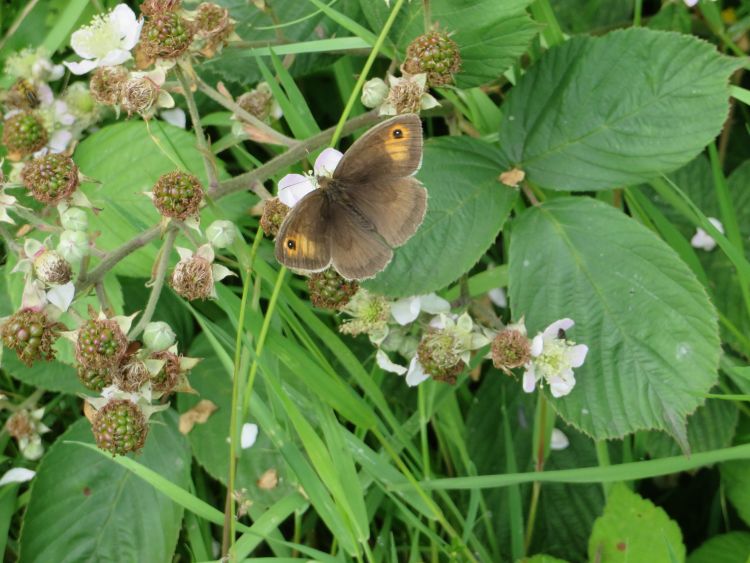
Meadow Brown butterfly on bramble flower
We were all very impressed with what Donna has done for wildlife in this five-acre field in North Antrim. It demonstrates what can be done for nature with patience and no high intensity input. We thanked Donna and James for a very instructive morning.
Field Trip report by Ernest Hunter