


 English
Sixteen members and guests met at Car Park 2 behind Lough Fea on Sunday 18th May at 8.00am. The sand quarry is closed on Sundays and the whole area is peaceful except for the birds. We were led by Claire Hassan and Ernie Hunter. Our walk was a copy of one previously led by our late esteemed member Shane McGarvey who had studied the cuckoos at Lough Fea in depth and had detailed knowledge about cuckoos which he loved to share with us.
Shortly after we assembled a male cuckoo obligingly started calling from its usual perch in the beech trees along Spawell Road just behind our car park. Then another male cuckoo started calling further away to the north up Tullybrick Road. The Cuckoo previously heard in the region of the gravel quarry did not perform on Sunday morning but two males calling out of the three known to be in the area was satisfying.
Shane always said the Cuckoos came to Lough Fea every year by St George’s day (that is the 23rd April) The males make the well-known distinctive call. Cuckoos have a distinct shape when perched with wings hanging below the bodyline and tail cocked up. There are grey and brown morphs—the Cuckoos at Lough Fea are the brown morph. Cuckoos have the superficial appearance of a sparrowhawk and are often seen as a threat and attacked by other birds including the Meadow Pipit.
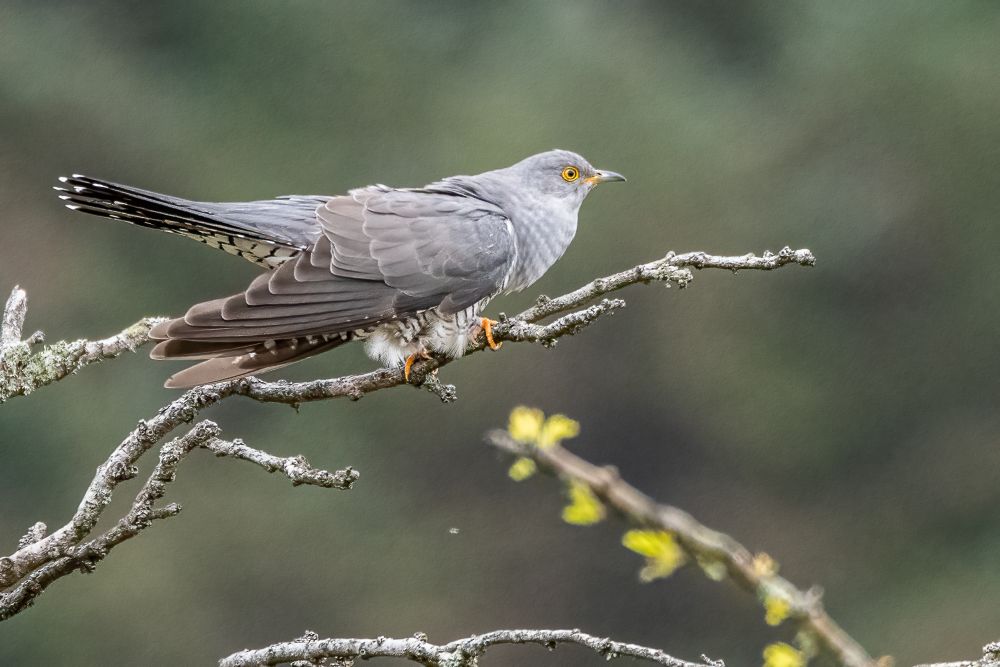
Male Cuckoo photo by Thomas Campbell
Male Cuckoos spend 6 weeks here calling, displaying, courting and chasing other males. While in pursuit flight males occasionally make an unusual leering call. After laying an egg the female sometimes makes a bubbling trill call.
After 6 weeks male and female cuckoos fly back to West Africa where they are not breeding and therefore remain silent. The BTO have fitted trackers onto cuckoos and have followed their migration path to and from West Africa.
The Cuckoo is an obligate brood parasite. That is it does not make a nest but lays eggs in other birds’ nests. Meadow Pipits are the target species in Ireland while Reed Warbler nests are the targets in England. Occasionally Dunnocks are targeted.
Our member Thomas Campbell had previously shown us photos of a male Cuckoo sitting while a Meadow Pipit repeatedly tried to pull at its tail feathers. He surmised that this was a diversionary tactic and possibly at the same time the female Cuckoo was sneaking into the Meadow Pipit’s nest!
It is known that the female cuckoo will remove or eat one of the Meadow Pipit’s eggs and lay her egg in the nest in less than 10 seconds! The cuckoo egg is slightly larger than the host bird’s egg but has identical markings to the eggs of the host bird whether it be Meadow Pipit, Reed Warbler or Dunnock. The female Cuckoo lays one egg per day in different nests and one bird has been recorded in a 6 week season to have laid 25 eggs in different nests!
Occasionally the host bird will recognise the cuckoo egg and destroy it but often do not realise anything is wrong. The cuckoo egg hatches quickly. The blind cuckoo chick then tips the eggs or chicks of the host bird out of the nest. Maternal instinct forces the Meadow Pipit or Dunnock to continue feeding the relatively enormous cuckoo chick.
While the adult cuckoos return to West Africa in early June, the young cuckoos fledge much later and the juveniles fly to West Africa in August. The mystery is of course how do they know where to go and when do male cuckoos learn their typical adult call.
On Sunday morning we left the back carpark and walked northwards along the gravel path. As well as the Cuckoo we heard Blackcap, Woodpigeon, Wren, Goldcrest, Dunnock, Robin and multiple Willow Warblers one of which was seen. A Speckled Wood butterfly was seen basking on bramble leaves in the early morning sun.
At the end of the gravel path looking across the open moorland we saw a male Hen Harrier tearing at something on the ground and then it flew off. Walking down Spawell Road we were under the beech trees where the cuckoo had been calling from but he remained silent. The foliage was too thick to see him but he may have been watching us.
Two ravens flew over “cronking” . A Meadow Pipit was seen. A Collared Dove was heard with the typical three syllable song. Sharon spotted some Cuckoo Flower on the road verge with some Orange-tip butterfly eggs.
We drove up Spawell Road. As we came to the open moorland a Sparrowhawk flew towards Lough Fea. Numerous Meadow Pipits lifted off the road in front of us, some settling on the fence to give a close-up view. We stopped at the corner of Slaght Road at the Red Grouse Conservation area—we did not see or hear any Red Grouse—has anyone ever heard or seen one there!! The wind was surprisingly strong but after a long silence we then heard two Skylarks singing—continuously as always. The Skylark demonstrates how birds can breathe and sing at the same time by virtue of having two voice boxes or syrinxes one at the root of each bronchus. A Mistle Thrush posed. A Buzzard soared in the distance.
Down Tullybrick Road opposite Mill Lough the Sand Martins were active in and out of their holes in the big gravel bank. We noted two loads of gravel nearby and wondered about what protection Sand Martin nests have. Swallows were also seen overhead. A Willow Warbler was singing in a gorse bush very close by. And the Cuckoo started calling again from the distant trees.
We dispersed at 10.00am after a very satisfactory morning.