


 English
Sixteen members and two guests met at Lissan House Car Park on Friday 30th August at 8.15pm for a “Bat Walk” by kind permission of Sharon Loughlin and Lissan House Trust. We were led by Mark Smyth. This was our second attempt to hold this event having been forced to cancel 10 days previously due to rain and wind. But this time conditions were just right— dead calm, dry and reasonably warm.
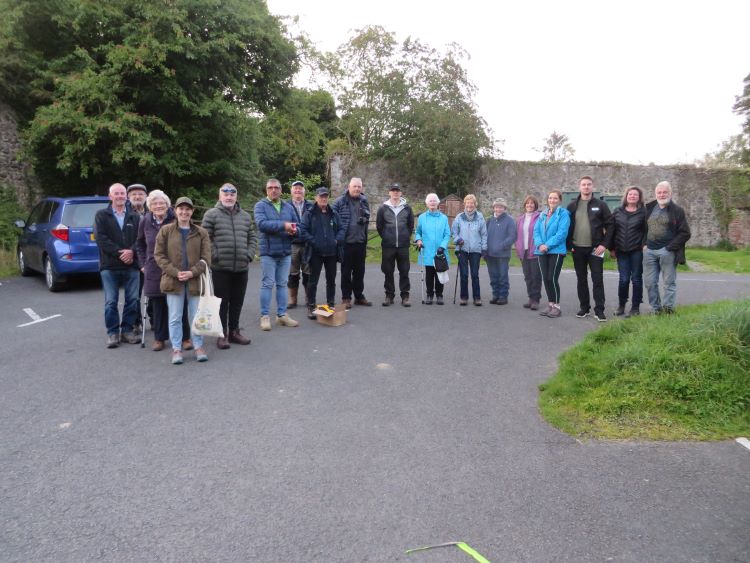
We had the opportunity to try out our recently purchased bat detectors with Mark explaining how to use them to detect bat echolocation sounds inaudible to human ears.
Mark explained there are 7 species of bat in Northern Ireland and 8 on the island of Ireland. We do not have the Lesser Horseshoe Bat present in Southern Ireland.
England has 23 species of bat. Bat species account for 1/4 of all mammal species on earth being much more numerous closer to the equator.
Bats produce one pup per year born in May/June. At birth a pup can be 1/3 the mother’s bodyweight. As mammals they are of course suckled. The pups start to fly in July and may be seen flying with their mothers while being taught hunting skills. The pups become independent after a few weeks but unfortunately the majority of pups do not gain enough weight to survive their first winter hibernation.
To hibernate properly bats need to remain at <5 degrees centigrade. If during hibernation their body temperature rises to more than 5 degrees centigrade they may wake up and start moving about. This burns up vital fat reserves reducing their chance of surviving the winter.
Our tendency to remove standing dead trees for human safety reasons has created a scarcity of hollow trees which most Irish bats prefer for roosting. Mark explained a lot of artificial wooden bat boxes do not have a stable enough low temperature and fail to attract wintering bats. While very expensive, the best artificial bat boxes are those made from woodcrete. These have a more stable temperature for hibernating bats.
Mark was speaking a few minutes before sunset. He was just explaining that Leisler’s emerge about 15 minutes before sunset, emit low frequency echolocation sounds, are a larger species of bat usually seen flying high not following any linear features. On cue a Leisler’s bat was then picked up on our detectors at 25 Hertz and then seen flying high over the car park. We quickly learned that the best way to observe bats at dusk is to look towards the west so that flying bats are silhouetted against the fading light.
We moved into the farmyard area where we detected and then saw Common and Soprano Pipistrelles.
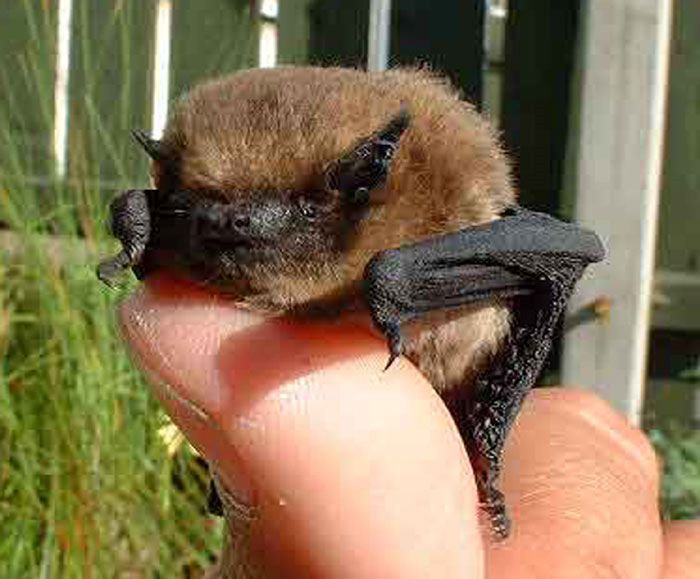
Common Pipistrelle Bat Photo by Mark Smyth
We moved to the Icehouse –no bats seem to roost there. Mark noted mosquitos inside there and brought one out in a specimen jar. In the icehouse area at a very high frequency Mark detected a Myotis type bat which he thought most likely to be a Whiskered Bat. They tend to frequent human habitations.
We were then in complete darkness walking along the paths with our torches.
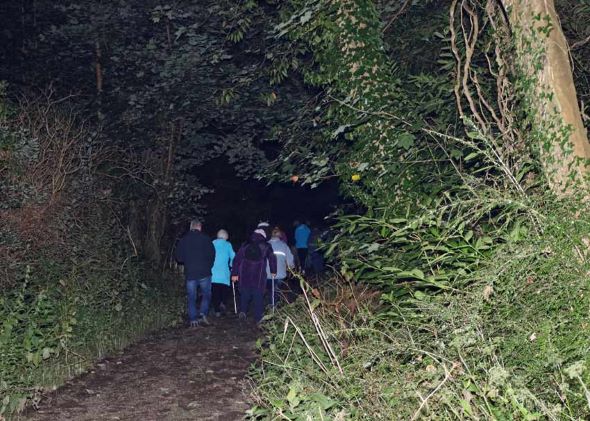
We went down to the weir and sluice gate where we noted a Daubenton’s Bat flying along the surface of the water. It then strangely flew vertically upwards and did not return.
Sharon had previously seen bats flying round the famous old yew tree. And indeed there we detected the echosounds of Soprano Pipistrelle.
At the “White Bridge” we detected Leisler’s, Brown Long-eared and Soprano Pipistrelle but somewhat surprisingly no Daubenton’s bats. Brown Long-eared bats only emerge well after darkness has fallen and therefore are rarely visualised.
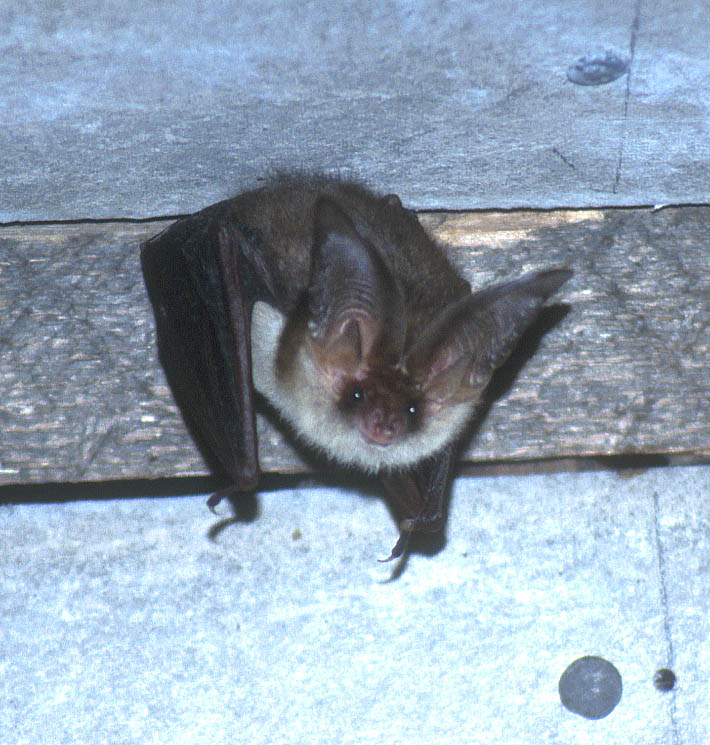
Brown Long-eared Bat (photo by Mark Smyth)
Back at the farmyard in the old creamery area there was further activity with Leisler’s and Soprano Pipistrelles detected. While there Mark explained that some of the low frequency 20 HZ “wet noises” some of us were picking up on our detectors are in fact the social calls between bats rather than echolocation hunting sounds.
On our bat walk at Lissan House Estate that night we detected six of the seven species of Northern Ireland bat.
The Chairman thanked Mark for leading us on a most successful, interesting and educational event. He also thanked Sharon and Arnie Loughrin and Lissan House Trust for facilitating our visit. Lissan Estate is a terrific wildlife haven and never fails to provide interesting material both by day and by night. We dispersed shortly after 10pm.