


 English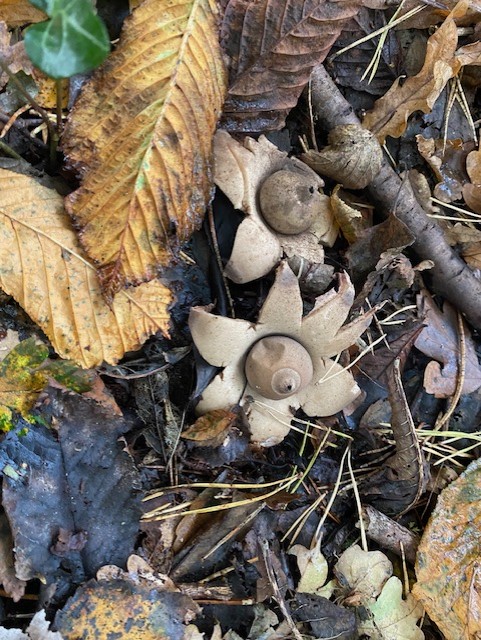
On Saturday 14th October, 26 people (25 adults and one toddler) visited Springhill, a National Trust property outside Moneymore, for a Fungi Foray. It was a bright, autumnal morning and we headed off into the woodland with our fellow member and expert fungi guide, Jackie Arrell.
The first species we encountered was the Shaggy Inkcap. Its fruiting body is usually torpedo-shaped but this particular specimen was well into the process of decay and a black slimy fluid full of fungal spores – ‘the ink’ was visible on the surface instead. In the 17th and 18th centuries, this black liquid could be used as an ink substitute. Later on in our walk, we found perfect examples of the Shaggy Inkcap as the white torpedo cylinders and as bell-shaped caps.
Only a few more steps were taken before more fungi appeared. There were remnants of Sulphur Tufts on the side of a tree stump and a fresh crop of Horse Mushrooms were found not far away. Jackie then came across some Common Puffballs and we were all entertained by the smoke-like cloud of spores which were ejected when the surface was compressed.
We were then shown a fungus with a very appropriate name – Artist’s Bracket. When the fresh white pore surface is scratched, visible brown lines are revealed that become permanent once the fungus is dried. It can therefore be a drawing medium for artists. Another aptly named fungus, Candlesnuff, was found close by on a dead branch and it closely resembled melted candle wax.
One of the most impressive species was that of the Collared Earthstar. Initially, they were well camouflaged among the leaf litter but once Jackie pointed them out, they were actually quite abundant. This species also releases its spores in a similar way to that of the Common Puffball.
Two fungi which are very alike in appearance are Dead Man’s Fingers and Dead Moll’s Fingers. Fortunately, we were lucky to see both and Jackie gave us a helpful identification tip. The latter has a much narrower base compared to Dead Man’s Finger and this was easily visible.
Fungi can be very dainty and delicate. A few dead branches were adorned with the beautiful yellow/orange Small Stagshorn. What a striking little fungus! Beside the Small Stagshorn on one of the branches was a miniature example of the gelatinous Purple Jellydisc - another impressive sighting.
There are many characteristics unique to each species of fungi. Jackie found an example of Woolly Milkcap and demonstrated how a milky substance is expelled when the gills are damaged. The upper part of this fungus also exhibits a wool-like texture!
Perhaps the award for the fungus with the best name would go to Lemon Disco. Jackie produced a large branch with hundreds of these tiny yellow cups. It was an incredibly colourful piece of dead wood!
The Honey Fungus was found in one part of the woodland on some dead wood. It can present itself like bootlaces, known as rhizomorphs, and are found underneath the bark. This fungus can be very destructive to trees, particularly because these rhizomorphs also travel underground and can spread up to 1 metre per year.
We tend to search the woodland floor for fungi but Jackie informed us that the Porcelain Fungus can grow in large tufts quite high up in Beech Trees. Sure enough, this was exactly what we observed. Some can fall from these heights onto the ground below. The smallest fungus of the day was also associated with the Beech Tree – the Beechmast Candlesnuff. This tiny fungus grows from the hard outer cases of Beech nuts. Well done to Jackie for finding us an example of this minuscule fungus.
It really was a fantastic fungi foray and many, many more species were encountered. Jackie’s knowledge of fungi is incredible and we are very grateful to him for leading this thoroughly enjoyable event. He really opened up our eyes to the wonderful world of fungi. Much appreciation is also forwarded to the team at Springhill for accommodating us. Many of the group enjoyed refreshments in the Springhill café afterwards.
Species List: Shaggy Inkcap, Horse Mushroom, Sulphur Tufts, Common Puffball, Artist’s Bracket, Candlesnuff, Collared Earthstar, Trooping Funnel, Mazegill, Common Earthball, Turkey Tail, False Saffron Milkcap, Woodpink Gill, Birch Woodwart, Pestle Puffball, Velvet Shank, Dead Moll’s Fingers, Small Stagshorn, Tawny Funnels, Woolly Milkcap, Earthy Powdercap, Meadow Waxcap, Purple Jellydisc, Lilac Fibrecap, Birch Bolete, Lemon Disco, Fairy Inkcap, Beechwood Sickener, Beech Milkcap, Hen of the Woods, Deceiver, Dead Man’s Fingers, Honey Fungus, Porcelain Fungus, Lilac Bonnets, Beechmast Candlesnuff, Clouded Agaric, Clustered Bonnets, Deer Shield, Smoky Bracket, Ochre Coral, Blusher, Glistening Inkcap, Lilac Fibrecap, Shaggy Scalycap, Blackening Waxcap, Beech Tarcrust, Sycamore Tarspot, Yellow Waxcap, Jelly Ear
Field Trip Report by Claire Hassan