
Translate
 Select
-
 English
-
Kiswahili
-
Afrikaans
-
هَوُسَ
-
Asụsụ Igbo
-
اَف صَومالي˜
-
Yorùbá
-
isiZulu
-
Français
-
Dansk
-
Svenska
-
Norsk
-
Íslenska
-
Suo̯men
-
Català
-
Cymraeg
-
Gaeilge
-
Deutsch
-
Galego
-
Nederlands
-
Euskara
-
Italiano
-
Español
-
Português
-
босански
-
Українська
-
Slovenski
-
Slovenčina
-
Srpski
-
Русский
-
Română
-
Polski
-
Lietuvių
-
Latviešu
-
Magyar
-
Eesti
-
Český
-
Hrvatski
-
Беларускія
-
Български
-
Shqip
-
Ελληνικά
-
Македонски
-
ქართული
-
বাংলা
-
ગુજરાતી
-
ພາສາລາວ
-
தமிழ்
-
Sinugbuanon
-
Монгол хэл
-
ភាសាខ្មែរ
-
Basa Jawa
-
मराठी
-
آذری
-
Հայերեն
-
اردو
-
Türkçe
-
Tiếng Việt
-
ภาษาไทย
-
فارسی
-
Bahasa Malaysia
-
조선말
-
日本語
-
Bahasa Indonesia
-
मानक हिन्दी
-
עברית
-
Filipino
-
漢字
-
汉字
-
العربية
-
Kannaḍa
-
తెలుగు
-
Hmong
-
नेपाली भाषा
Spring is an important time of year for birds when they start making nests to raise their young. Each species of bird has their own type of nest and most of these fit into five types.
The first type are Cup shaped nests which are the most common. These are smooth inside with a deep depression to hold the eggs. They are made from mud, twigs mosses and grasses and can be found on trees, shrubs and in out buildings. Song thrushes, blackbirds and warblers all make this very comfortable looking nest.

Cup nest
March is the traditional month when hares go crazy! If you are lucky enough you may see them dashing after each other or getting up on hind legs and engaging in boxing matches. This is courtship behaviour. The boxing matches are between a male and a very angry female trying to fight of his advances!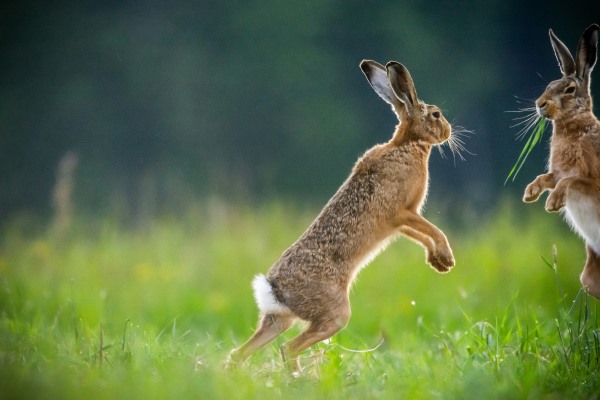
Hares boxing
Northern Ireland is home to both the Brown or European Hare which was introduced to Ireland in the mid to late 19th century and our native Irish Hare which is one of Ireland’s few native mammal species. In Mid Ulster the Brown hare has largely replaced the Irish species and there is evidence of the two interbreeding which is a problem as the Irish hare is unique to these islands. Originally thought to be a sub species of mountain hare there is now also evidence which supports the feeling that the Irish Hare should be given species status.
Fantastic February
On the 1st of February Candlemas or the Festival of Imbolc is celebrated. This honours the passing of winter and the return of spring. February is so exciting as it is all about change with lengthening days, milder weather and animals and plants becoming more active.
The vegetation is still quite sparse, so spotting animals is relatively easy especially when it involves small creatures like stoats and wood mice. Male stoats become very active during February securing territories and looking for mates while the females are kept busy searching for potential den sites in which to have their young (called kits). The breeding season of the tiny brown wood mouse is between February and October These creatures can produce litters of four to eight up to six times in one year. It’s just as well they do as most mice die within their first year!
Female foxes are pregnant and towards the end of the month start to look for a den or earth to give birth in. Badgers on the other hand are both breeding and having cubs These cubs will emerge from their setts in late spring and early summer when the weather is warm, and food is abundant. They are one of the few mammals that can conceive while pregnant which is why February is still their breeding season. The resulting embryos remain in the mother until the following winter.
Some of our mammals such as hedgehogs and bats are still in hibernation. Mild weather may waken them so in the case of the hedgehog it is advisable to continue to provide food and bedding for them. If it becomes cold again, both animals will return to their hibernating state.
With a New Year comes hope for the future and that includes for our wildlife as well. There are many threats to wildlife in the UK but with knowledge and a willingness to help we can do a lot to overcome the problems.
Read more: A big hello from Percy Pine Marten and welcome to 2024
Animals associated with Christmas.
There are a variety of wild animals which are associated with this magical time of year. These animals can be seen on television, films, on Christmas cards and wrapping paper and even as Christmas tree decorations. Here are the ones Percy Pine Marten can think of. Perhaps you can think of more?.
Robin
It has been estimated that there are about 6,700,000 robins in the UK. They are so easy to identify with their olive brown upperparts and that distinctive red orangey breast. They live in gardens, hedgerows, parks and woodlands and eat insects, berries, seeds and worms. The stories of why the robin is associated with Christmas revolves around its red breast. One version is that the robin’s redbreast provides a link to Christianity. The robin it is said pulled a thorn from Christ’s crown whilst he was on the cross and then sang to relieve his suffering. Another similar legend also connected with Christianity says that some of Christ’s blood fell upon the bird’s breast when Christ was on the crucifix. Folk stories also explains the robin’s redbreast. An Irish folk tale tells the story of a father and son who were out in very cold weather at Christmas. They couldn’t find any shelter except for a bush. The father lit a fire and told his son to watch the fire and not to let it go out. However, the son eventually falls asleep, the fire gets lower, and a starving wolf comes closer. Luckily there is a little bird who on seeing what is happening begins fanning the fire to keep it a light thus scaring the bad wolf away. Even when his breast got scorched the bird continued and from then on, the robin has got a red breast. Another tale altogether different relates to Victorian postmen who wore red uniforms and were called Robins. So the robin on the Christmas card came to represent the postmen who delivered the card.
Keeping garden animals happy in the winter
The north wind doth blow. And we shall have snow. And what will poor robin do then, poor thing? He’ll sit in a barn and keep himself warm. And hide his head under his wing, poor thing.
Children Wildlife Page by Maureen Graham
Hello children this is a page especially for you! Every month Percy Pine Marten will tell you what animals or plants to look out for. He will select a special animal or plant to talk about and show you how to make things as well!
At this time of year, the weather starts to become colder, leaves fall from the trees, and there are fewer flowers and insects to be seen. However, Percy Pine Marten says this is a good time to watch out for squirrels and jays and even mice who are all busy collecting hazelnuts and acorns to bury as a food store for the winter months. Some animals will hibernate or semi hibernate. Semi hibernation is a lighter state of sleep. It is called torpor. Hedgehogs are an example of this. They will emerge to look for food if conditions are not too cold. Bats are hibernating in trees, lofts, in buildings, tunnels and even caves. The Horseshoe bat likes caves. They hang upside down with their wings wrapped around their bodies. They look like little umbrellas. Some insects go into a state of dormancy. For instance, the Small Tortoiseshell Butterfly likes to go into cool dark sheds or houses to go to sleep The Large White Butterfly overwinters as a pupae attached to walls of houses. Ladybirds spend from October to February often in large groups in sheds, parts of plants and even in special ladybird houses.
The Natural History Museum's 'Young Wildlife Photographer of the Year' competition will be open for entries from 16th October to 7th December 2023.
Information on how to enter this competition can be found here.
Are you a birder with old binoculars/scopes that you no longer use? You may be interested in donating them to the BTO Equipment Donation Scheme. Your donation will be sent to young people, schools or university groups who currently don't have access to birdwatching equipment.
Are you a young person, school or university group? You can apply to receive birdwatching equipment through this scheme.
All the details on donating and receiving equipment can be found here.
The RSPB has developed a range of excellent resources for young people to help them to engage with nature in a fun and proactive way!
The activities can be found here.
