


 English
Why are hedgehogs called hedgehogs? Basically, it is because they like to live near hedgerows and the ‘hog’ part comes from the snorting noise rather like a pig which they make. There are other different names for hedgehogs. In medieval times they were known as urchins, they can also be called hedgepig, furze-pig or the wonderful sounding hotchi-witchi which is a Romany word. Their Irish name is An Grainneog which means ‘little ugly one’! It is strange that they were viewed in this way as now they are considered cute! Of course, one of the most famous hedgehogs is Mrs Tiggy Winkle, the washerwoman from the Beatrix Potter’s stories and I am sure everyone is familiar with Sonic from the Sega game, that blue hedgehog with attitude!
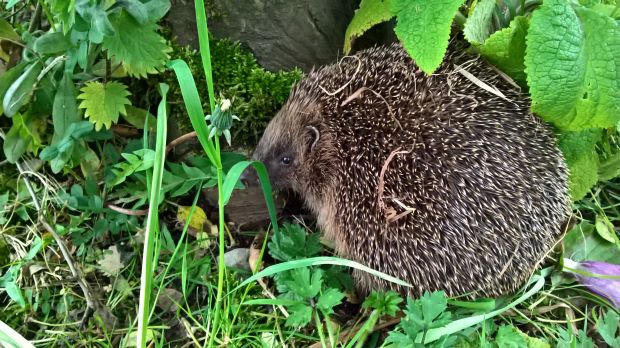
There are thought to be 17 species of hedgehogs (some say 19) found in Europe, Asia and Africa. The European hedgehog was introduced to New Zealand in the 1870’s to make British settlers feel at home!
European hedgehogs are probably the largest species weighing over 800 gms and growing to over 12inches in length They are native to mainland Britain but are not native to Ireland where it is thought they were introduced, probably by the Normans, around the 13th century as a food source. There are no hedgehogs native to Australia or the Americas.
Many people assume they are related to porcupines because both creatures have spines, but porcupines are rodents and hedgehogs are not. Instead, they are distantly related to shrews and moles. Solitary animals, it is rare to find hedgehogs in groups but when they are together there are as known as an array or a prickle! They also are quite vocal and can make a variety of sounds such as hissing, chirping, snorting and a clicking noise which they utter when unhappy!
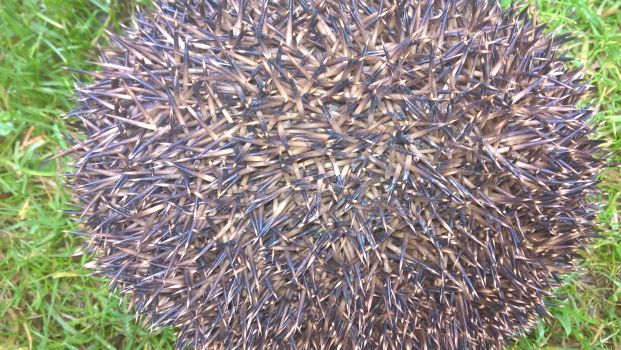
The most distinctive feature are their spines (see photo above) An average hedgehog will have about 6000 sharp spines on their upper body. These are not detachable and are made from keratin the same material as hair and nails. Now and then the spines will be shed and replaced by new ones If threatened they can roll tightly into a ball. The hedgehog has a muscle around its body which contracts to allow the animal to curl up—rather like a draw-string bag! Some desert species with fewer spines will flee or even attack an intruder rather than curl up. The head, sides and underbelly of the European hedgehog has no spines just thickish coarse hair.
They possess a small tail which is hidden by their spiny armour. They also have longish legs which are visible when they run, and hedgehogs can run very quickly! Their feet have five claws which helps in digging for food and climbing rough surfaces. They can also swim, if necessary. Our hedgehogs have small ears but some such as the Long-eared hedgehog found in Asia can have ears reaching up to five cm in length! I don’t think Mrs Tiggy Winkle wore glasses but she probably should have as hedgehogs have poor eyesight. They rely on smell and hearing and not sight.
Most are chocolate brown in colour. Rarely will an albino white hedgehog with pink eyes be seen. In Alderney, in the Channel Islands nearly half of the hedgehog population are ‘blondes ‘having creamy spines and dark eyes. This is a product of recessive genes and having a small gene pool with which to choose potential mates from. It is thought that these hedgehogs were introduced post-war period and that at least one of them came from the pet department in Harrods London! The pale colouring attracts predators which is why it is rare to see albino ones but in Alderney there are no predators, so the creatures thrive and are quite a tourist attraction.
Hedgehogs are nocturnal the exceptions are pregnant females, new mums or very hungry young. They sleep during the day in specially built nests hidden in bushes or under logs and sheds. In Autumn they construct a special nest called a hibernaculum. This is where they will hibernate. Hibernation depends on temperature and food and with our warmer winters it is not uncommon to see a hedgehog foraging for food in December or January. When a hedgehog hibernates its body temperature decreases to 2-5 c and they are in a very heavy sleep. When they are in this state of torpor they should never be disturbed as they will use up valuable body fats. A hibernating hedgehog has to weigh over 600 grams if it is to survive hibernation...
Once classified as insectivores many scientists now classify them as omnivorous as a hedgehog has a varied diet. They feed on slugs, snails, beetles, frogs, birds’ eggs, baby birds, small mice, carrion, mushrooms and even berries. At one time there was a belief that they drank milk from cows but most likely they were just lapping the milk from an overflowing udder of a sleeping cow! Because of this belief in medieval times hedgehogs in some areas were called the ‘farming fairy’ so farmers would leave a bottle of home brewed beer and cake for them! Hedgehogs have been known to kill snakes even the poisonous adder. The spines protect the hedgehog from a snake bite but if bitten in an area with no spines the hedgehog may die. There is still some debate if they have immunity from snake venom or not. It may be that some individuals have and will pass this down to their offspring. Another belief is that they will roll on windfall apples! These stick to their spines which they can then eat later. The most reasonable explanation for this is that it is all purely accidental although the theory has never been dismissed entirely.
Hedgehogs have a very peculiar habit of producing frothy saliva and then licking this over their spines. They are totally self-absorbed whilst doing this. It is called anointing and other animals such as squirrel monkeys, lemurs, elk, brown bears and jays, will also exhibit this strange behaviour Why hedgehogs do this is still a mystery? Scientists have found that it is mostly seen in young males and that the peak months are in July, August and September. Theories are many. It may be related to scent marking, or to a strange taste or smell, as a warning to predators, as camouflage helping to mask the hedgehogs smell and yet others subscribe it to grooming and killing parasites. I have seen this behaviour once in a young male animal which when confronted by the devil’s coachman (a beetle with pincer-like jaws and the ability to curl up their abdomen like a scorpion and emit a noxious substance) suddenly backed away, hissing and started then anointing himself with saliva. This went on for nearly half an hour. I think this may have had something to do with the nasty smell and rubbing the scent over the body may help the hedgehog to avoid this beetle in future.
Hedgehogs reach sexual maturity in the year after they were born. The start of the breeding season is in May and June. The male wanders many miles in search of a female. When he finds a female the courtship behaviour is very noisy and consists of the male circling around the female making a variety of noises from snuffling to screaming until she allows him to approach. This can take many hours When she finally succumbs to his advances she lowers to the ground and flattens her spines. During one season each animal is likely to have ten or more partners Their reproduction is not very efficient and quite a few females will not become pregnant. The male plays no part in caring for his offspring and indeed will kill and eat baby hedgehogs even if there are his own!
The mother will construct a special nest out of grass and leaves and after a gestation period of four and a half weeks the babies or hoglets (as they are called) are born. Hoglets are small, blind and pink. They are born with the quills still beneath their skin but within hours of been born whitish spines will emerge and after a week these change to brown. As they are mammals the female will suckle them until they are weaned at three to four weeks and at four weeks, she will then lead them on foraging expeditions. They follow their mother one behind the other. By six weeks they can fend for themselves. It is important to never disturb a nest if found as the mother will either kill her babies or desert them. The mother may have another litter in September, but these have little chance surviving the winter as they have not got enough fat reserves to sustain them. It is these babies that will often be seen during the day trying desperately to find food. More than half of all hedgehog babies will die in their first year and it has been estimated only 1 will still be living after 5 years.
Enemies of hedgehogs are badgers, foxes, pine martens, otters, stoats, owls and even rats. Badgers and hedgehogs like the same habitat and as they are both omnivores, they are in competition for food, so hedgehogs tend to avoid areas with too many badgers. It is easy for badgers with their very strong claws to unroll hedgehogs and kill them. Foxes on the other hand will wait until the hedgehog thinks danger has passed and when it unrolls the fox will pounce on it and kill it. Dogs sometimes attack and injure hedgehogs or kill them especially if it is a young hedgehog.
However, man is probably their biggest threat The destruction of habitat such as loss of hedges, the creation of tidy cemented gardens with artificial turf are not good for hedgehogs. The use of chemicals, pesticides, strimmer’s and ride on lawn mowers are all potential hazards. The increase in numbers of vehicles on the road are also factors for the hedgehog decline as the animal’s immediate reaction when confronted by a vehicle is to go into defence mode and roll into a ball.
Diseases affecting hedgehogs range from respiratory, intestinal and neurological conditions. Wobbly hedgehog syndrome may sound funny, but it is a killer to hedgehogs once caught. Internal parasites such as liver fluke and external parasites like an infestation of ticks can also be fatal. Fly strike occurs when flies lay their eggs on a wound and the resulting maggots eat the flesh leading to a painful death. Fleas do not generally worry a hedgehog The hedgehog flea is specific to hedgehogs which means if a hedgehog flea jumps on to a person they won’t stay long as it cannot complete its life cycle on anything but a hedgehog.
Helping hedgehogs is like helping all wild animals If you want them to live in your garden for instance leave parts of it untidy. Have a compost bin which is very attractive to hedgehogs as it not only contains food but also, they can create a cosy nest in it. Make or buy a hedgehog house which may be used by the hedgehog as a winter den ---no guarantees however! Chemicals especially insecticides should never be used in the garden. If parents are mowing or strimming, ask them to take a quick look in the grass to see that no hedgehogs are there. Bonfires should always be checked before lighting as hedgehogs and indeed other creatures find them attractive to live in. During autumn and winter leave out dry or wet kitten food (not the fish variety) so that if hedgehogs do waken up there will be food available for them if needed.
I have been rescuing hedgehogs for many years. They are overwintered with me and released in April depending on the weather. Over the years I have had some ‘characters’ This year I was given a mature male to look after. He was covered in ticks and having removed them (Ugh!) he repaid me by destroying an old rabbit hutch I had put him in to recover. Another one called Twiggy only had three legs. She stayed with me for over two years. She was a very nice gentle animal whose favourite food was chicken cat food. Some have not such a good temperament. I once had one that was very nasty, He would uncurl as soon as he heard me and if it was feeding time he would immediately come to the front of the cage for food and for a bite of my finger!
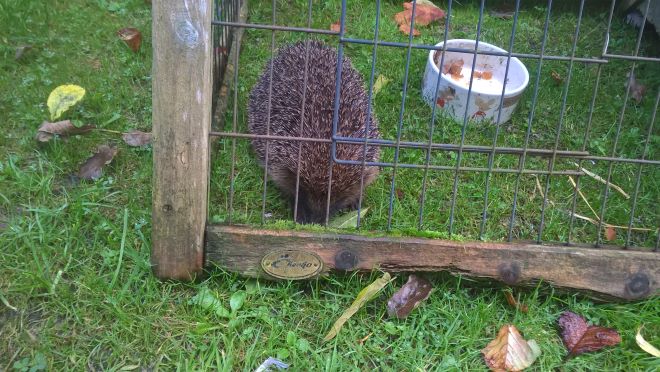
One of my rescue hedgehogs.
It is always advisable to release hedgehogs back to where they came from. Sometimes this is impossible due to housing development for instance. They are vulnerable to extinction in the UK. In Northern Ireland they have declined by 30% in the last ten years. It is not legal to keep the European hedgehog as a pet although in the last few years the African pygmy hedgehogs can be bought in pet shops These are very cute but they do not make great pets They are nocturnal ,they are quite noisy, they are not cuddly, they are active and require large enclosures and coming originally from Africa they need a warm regular temperature of 72-75 degrees Fahrenheit. Let’s not forget the many health issues they seem to have or the fact they can harbour salmonella bacteria without showing signs of illness themselves which can be passed on to humans.
Finally, if you discover a hedgehog out during the day and at this time of year watch it carefully and note the following: Did it curl into a ball when approached? Is it more rugby ball shape than a round football? Perhaps it hasn’t curled up at all These are warning signs that the hedgehog needs help. Please wear gloves to inspect it for cuts, ticks and fly strike. Get in touch either with a vet or a hedgehog rescue centre. If you think you can manage to look after it then place it in an old cage such as rabbit or dog cage add layers of paper, old blankets or dry leaves, hay or straw so it can make a cosy nest. A dish of water and another dish of dried kitten food should be given and leave the cage in a quiet dark place such as an outhouse. Keep an eye on the food-- just because it is disappearing does not mean it is the hedgehog that is eating it –it could be mice or even rats! Hedgehogs are dirty creatures so always wear gloves. Hopefully it will survive the winter and can be released the following Spring. It’s very rewarding rescuing hedgehogs but it is challenging at times and it does require a level of commitment.
Children's Page written by Maureen Graham
MAKING A HEDGEHOG FEEDING STATION
Even though hedgehogs will be hibernating soon there are still times when they emerge and look for food and of course those small babies born in late August and September need a lot of food if they are to survive. A cat proof feeding station is easy and cheap to make.
ADULT HELP REQUIRED
YOU WILL NEED.
Long plastic storage box with a lid
A large corner bend pipe –type used for toilets or 8 bricks, heavy stone
Roof tile
Kitchen knife
Newspaper
Food i.e. dried kitten food, hedgehog food from a pet shop
METHOD;
1. Cut an entrance hole in the plastic box about 13cms x13 cms in one side.
2. Cover any sharp edges with parcel tape so that the entrance is safe for hedgehogs to enter.
3. Try building a tunnel. This is to prevent cats from eating the food. Insert a pipe into the hole or make the tunnel with placing 4 bricks on each side of the hole. Put something like a roofing tile on top of the bricks and maybe another on the top of the lid just to make sure that a cat, dog or fox doesn’t try to enter this way.
4. Place a sheet of newspaper on the floor of the box (for easy cleaning) and then add food in a shallow dish and water in another dish
5. Some people say if you place the food station in the middle of the lawn this will deter rats and foxes as these animals don’t like open spaces.
6. A sign that hedgehogs are visiting are an upturned feeding dish and their droppings which are black and pointed at both ends. They don’t smell too nice!