


 English
FLITTERMOUSE Part 2
Northern Ireland has 8 species of bats namely the common pipistrelle, the soprano pipistrelle, the nathusius’ pipistrelle, the whiskered bat, the brown long-eared bat, the daubenton’s bat, the natterers bat and the leisler’s bat. Southern Ireland has one extra bat, the lesser horseshoe bat which have not yet been found in the North.
The common pipistrelle is the smallest and most common bat. It can eat thousands of insects in one night and is the most likely bat to be spotted in the garden. Their flight is fast and jerky. These are the species often found roosting in houses and a tell tail sign there are present are their droppings on outside walls and windowsills. The droppings resemble mouse droppings but can easily be distinguished as they are softer and will crumble to a fine powder when touched whereas mouse droppings won’t and are also very smelly!
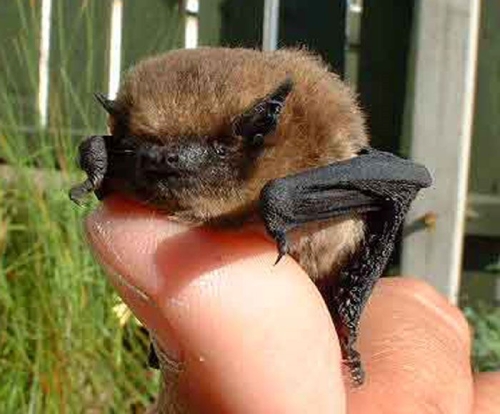
Common Pipistrelle (Photo by Mark Smyth)
The soprano pipistrelle looks like the common pipistrelle although it is slightly smaller. It was only in the 1990s that it was identified as a separate species. The easiest way to tell the two apart is from their echolocation calls as sopranos echolate at a higher frequency. They live in woodland, hedgerows, farmland and towns. Their preferred roosting sites are in buildings ranging from newly built bungalows to grand old mansions. Tree hollows and bat boxes may also be used. Emerging from the roost just after sunset they catch and eat flies and other insects on the wing. This is called aerial hawking. Sopranos prefer to forage in habitats associated with water and may be a more specialist feeder than the common pipistrelle.
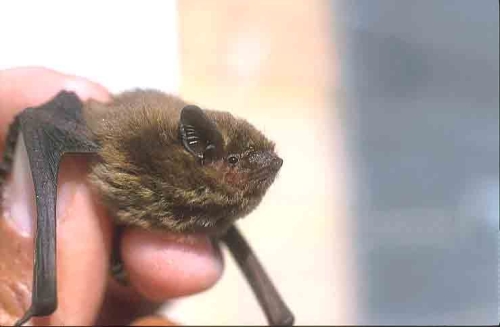
Soprano Pipistrelle (Photo by Mark Smyth)
The common pipistrelle has smaller colonies than the soprano which can have large colonies of up to 1,500 individuals. If they are roosting in your house or in an outdoor building the smell from so many accumulated droppings can be a problem. During summer the males attract females from July to September by making song flights around their roosts. Populations of both species have declined due to modern agricultural practices and their reliance on buildings makes them vulnerable to renovations and toxic chemicals.
The nathusius’ pipistrelle was first confirmed in Northern Ireland when a colony was discovered in 1997 near Lough Neagh. Since then, it has been found across the province. As it appears like the other pipistrelles it may have in the past been under recorded but now with more research our knowledge about this bat should improve What we do know is that it has medium dark reddish-brown fur and a pale brown belly. It is slightly larger than the common pipistrelle with broader wings. In Europe it is classed as a migratory species, but this is probably not true of the Irish population. Again, more studies are needed.
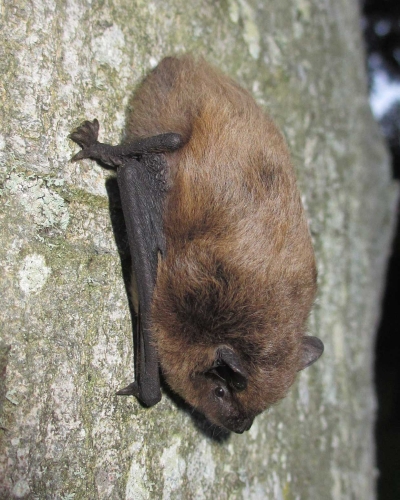
Nathusius' pipistrelle (photo by Mark Smyth)
Long eared bats, sometimes called whispering bats are lovely! Medium size they are our second most common species in Northern Ireland. They can’t be mistaken for any other bats because they have very long ears almost as long as their body. The fur is light brown, long and wispy. When flying their ears point forwards and because of this the resulting wind resistance makes flying hard work. Having said that they fly slowly which saves energy. Surprisingly they are still highly manoeuvrable They can also hover which means they can pick caterpillars and spiders off tree branches and leaves. This way of hunting is called gleaning. Their eyes are large and bright which suggests they use their eyesight as well as echolocation to locate prey. It has a very quiet precise echolocation where its huge ears are tuned to hear very faint echoes from their prey. Their calls are so quiet that even bat detectors can find it difficult detecting them. Large prey is taken to a favourite feeding perch where piles of insect remains collect under them. They like to live near houses. Their pups are born in a nursery roost in April often in attics which are warm. Mostly bat maternity roosts hold nothing but females and their young but unusually this is not the case for long eared bats as males will also be found. When the mother returns to her pup after foraging she will recognise her own young by firstly their call and then by their smell. Survival rates in these bats are quite high but if the summer is poor or the winter extended fewer young will survive. Their life span can be from 10 to 20 years. Like all bats they are affected by chemicals used on house timbers. Cats will often kill them although they will not eat them as they find all bats distasteful.
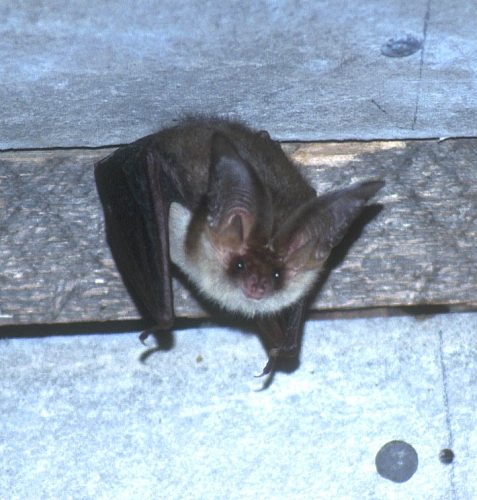
Long-eared bat (photo by Mark Smyth)
Whiskered bats prefer to live in houses, usually in attics or under house eaves. It is a small bat with long shaggy dark brown fur. The face is almost black. The ears are rather pixie shape and quite long and they have narrow wings which enables them to zip and weave after swarms of small insects. The flight can be described as rapid fluttering, and they will fly a regular route repeatedly. During summer they roost in buildings and trees When hibernating they move to caves and cellars or other humid places where they will not dehydrate. They usually hang against the walls. These bats unlike other British bats which become sexually mature at two years old can breed when only three months old. Unfortunately, they are not very common in Northern Ireland and only a few roosts have been located They are vulnerable to timber treatment and chemicals used to kill woodworm and fungus. Predated also by cats and owls.
Daubenton bats and natterers bats are close relatives of whiskered bats and they do resemble each other. Daubenton --or water bat--- differ from the natterers species in having a snub nose and smaller ears. They never really leave rivers and can be seen at dusk skimming very low over still water in search of caddisflies, mayflies and midges. Sometimes they will use their large feet to scoop prey from the water. This is known as trawling. They can even swim if they make a mistake and fall into the water! They like to roost under stone bridges, in caves, tunnels and trees and they will hibernate in cold sites. It has been said that they can carry a form of the rabies virus. However Northern Ireland has been rabies free since 1923.
Natterer’s bats are rare and have a long narrow muzzle and quite long ears. The face is reddish brown with a bare pink muzzle. It has a bright white belly. They have broad wings so can fly with great manoeuvrability among trees and hedgerows. They sometimes glean insects from foliage and have stiff hairs on the tail membrane which may help to trap or hold its prey. Shrubby and wooded areas or open parkland are preferred, and they are mostly found in hollow trees, and beneath bridges and inside caves.
Leisler’s bats are also called the Irish bat or hairy armed bat! They are our largest bat and may be found roosting in trees and old and new buildings. With its longish reddish fur especially around its shoulders it looks as if it has a lion’s mane! It is one of the first bats to emerge in the evening flying high and fast in the open or sometimes flying very close to the ground along country lanes and well-lit roads. It has been known to roost in bat boxes and even on occasions have been found sharing bat boxes with pipistrelles. After a few days they may move to another roost. Hibernation is in tree holes, caves and tunnels They are also quite vocal producing loud metallic sounds. Ireland is a stronghold of this species. It is rare in Britain and for this reason the Irish population is considered of international importance. In Europe it is regarded as migratory but probably this is not the case in Ireland. Tree felling and the use of the drug ivermectin for controlling livestock parasites are all detrimental to the bat’s survival.
Bats are schedule 1 protected species under the Wildlife and Countryside Act as are their roosts even if these are not habited. Large fines of up to £5000 per animal can be issued to anyone harming bats and even a 6-month prison sentence can be given. If for some reason bats have become a nuisance, a very large roost in your attic for instance, then authorities must be notified which in Northern Ireland is the NIEA.
Sometimes bats, often the young ones will enter inside the living area of a house. If this happens open the door and windows, turn off lights inside and if possible, turn on an outside light and leave the room closing the door behind you. The bat should fly out on its own accord. If not, it may be exhausted or injured so use a piece of cardboard to gently lift the animal, put into a box with an old towel and add a shallow container such as a jampot lid filled with water for the animal to drink. Cover the box with a lid (with ventilation holes!). Wait until it is dark to place the box outside and hopefully the bat will have recovered and will fly away. If not get in touch with the Northern Ireland Bat Group (information on their website) who have people trained and licenced to take care of bats.
We can help bats by doing the following. Plant native trees and flowers which will attract lots of bugs for bats to eat. Leave dead or dying trees as they may be used as roosting sites. Start a compost heap as lots of bat prey will live in this Stop mowing parts of the lawn as this can harbour insects A pond even a small one attracts midges and aquatic larvae liked especially by the pipistrelles. Reduce light pollution by using low intensity garden lights. Avoid pesticides and chemicals. Keep cats indoors at night as they will patiently wait outside bat roosts to pounce on the unsuspecting bats and lastly some bat species will use bat boxes so buy or make these and hang them on buildings or trees.
And lastly maybe think twice before picking an evil looking batty outfit for those Halloween parties because as we have seen labelling bats as nasty and horrible couldn’t be further from the truth!
MAKING A BAT BOX
ADULT HELP ESSENTIAL
NEEDED:-
Untreated rough sawn planks –about 200mmwide and 20mm thick.
Black paint.
1.Look at the internet for a plan of a bat box to download. Remember the opening of the bat box is at the bottom and leave the wood rough so that the bat has something to hold on to.
2.Once the box is made paint black.
3. Look for a spot away from bright lights which will have shade during the hottest part of the day. Southeast or Southwest is good
4. Place the box about 5 m above ground.
5. Place under eves of wood or brick buildings in groups of at least 3 to 10.
5. if sited on a tree, clear any branches below the entrance hole so that the bat has a free run in and out of the box.
Bats are very fussy about their houses especially when it comes to temperature and humidity so don’t be too disappointed if your boxes are not used especially in the first couple of years. Once bats have moved in the box can only be opened or moved by someone with a bat licence.
Bats which may come to the boxes are pipistrelles, long eared bats and if you are incredibly lucky the whiskered bat .
Books
‘ All things bats for kids’ by Animal Reads from Amazon
All about bats Dk Super Readers
Bats by Terry Mason
Bats by Phil Richardson
Bats by Tina Jackson
Flittermouse Part two written by Maureen Graham